


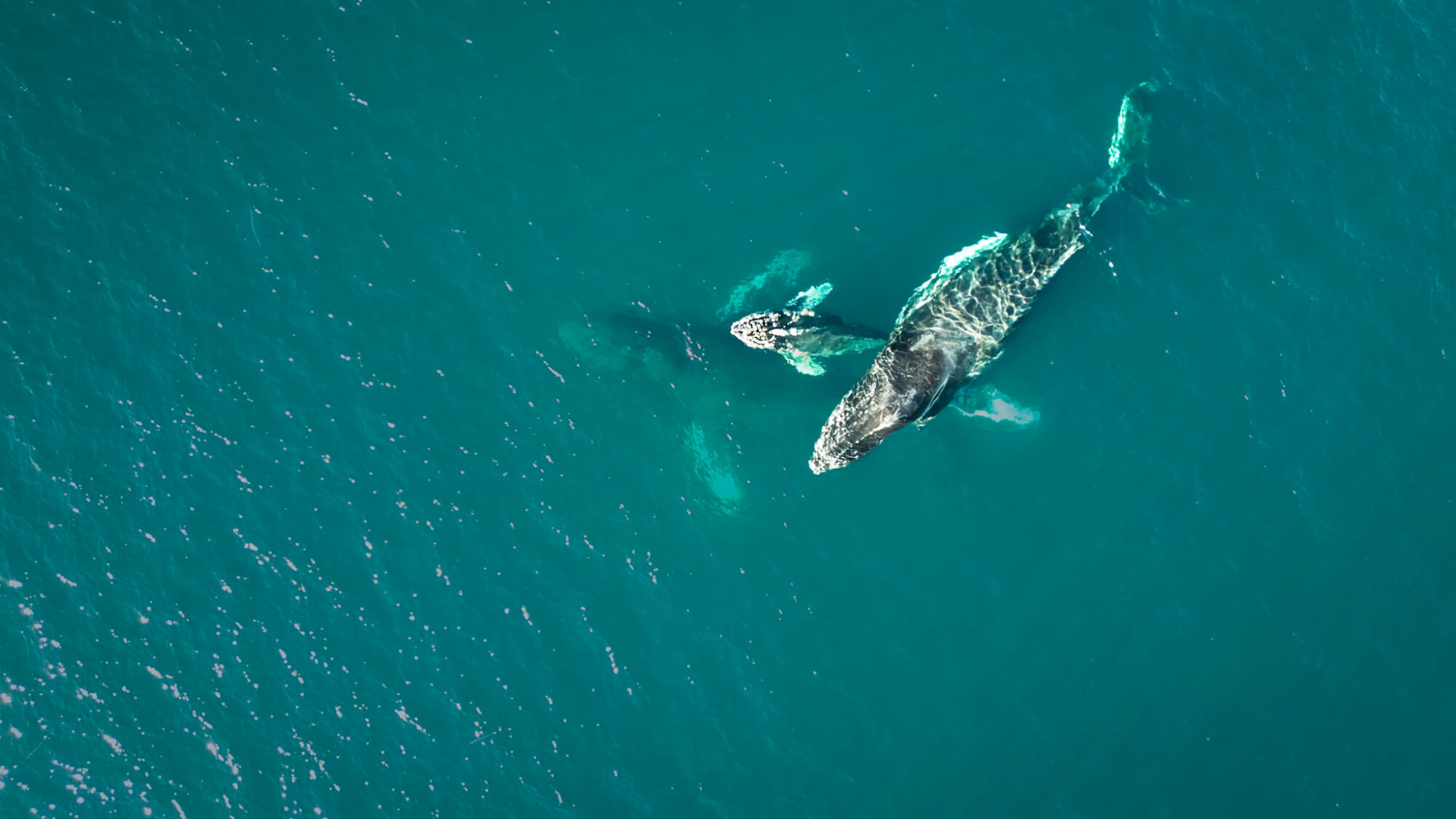
On the road with stragglers, leaping pupils and a rather skinny giant off Baja California
We are almost too late – and we feel it, too. But well, we are only almost too late. Most of the grey whales have already moved on by the time we arrive in the bay of Bahía La Almeja. The fisherman takes us out anyway. To where the sea flows into the bay. On the off chance, maybe one of these whales will show up after all.
The grey whale that is a straggler
During the summer months, the grey whales dedicate themselves to feeding in the nutrient-rich Bering Sea. But they spend the winter months in the warmer waters of Baja California. They give birth to their calves in the bays, because there they are protected from killer whales.
We head out to the entrance of the bay at full throttle. Long ocean rollers stretch along the coast towards Santa Margarita Island. In the middle, you can barely feel the swell, until a larger wave breaks prematurely after all. Our captain is constantly keeping watch – for the whales and for the waves.
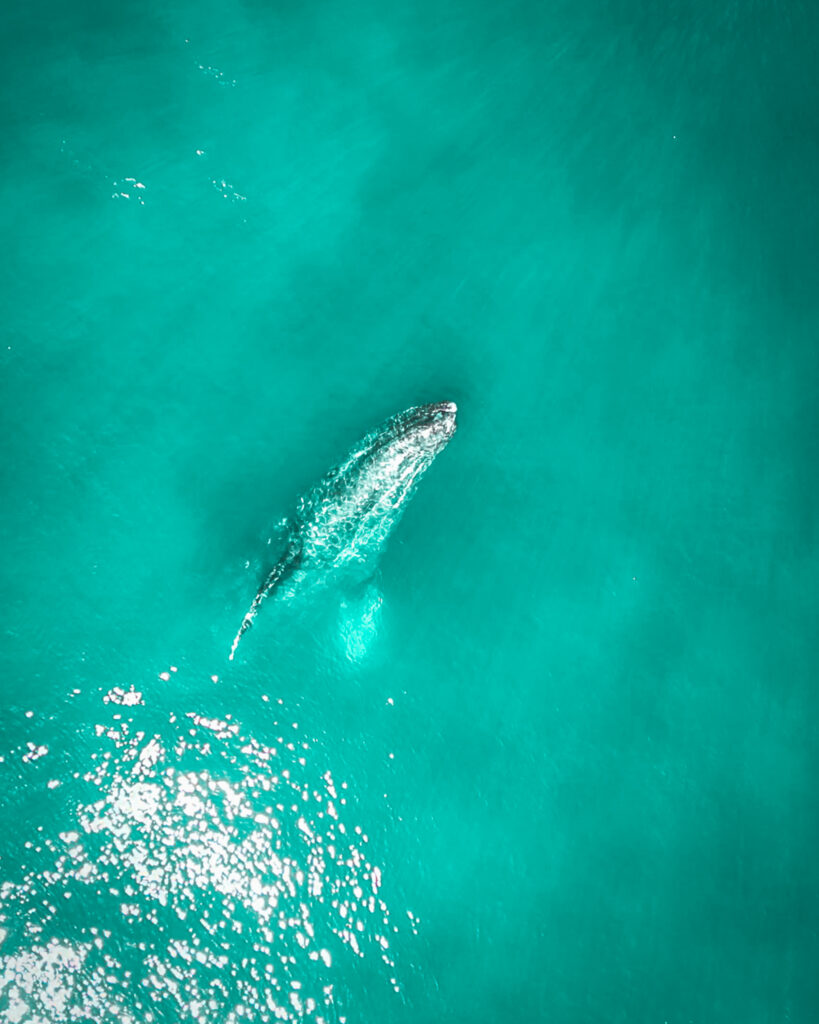
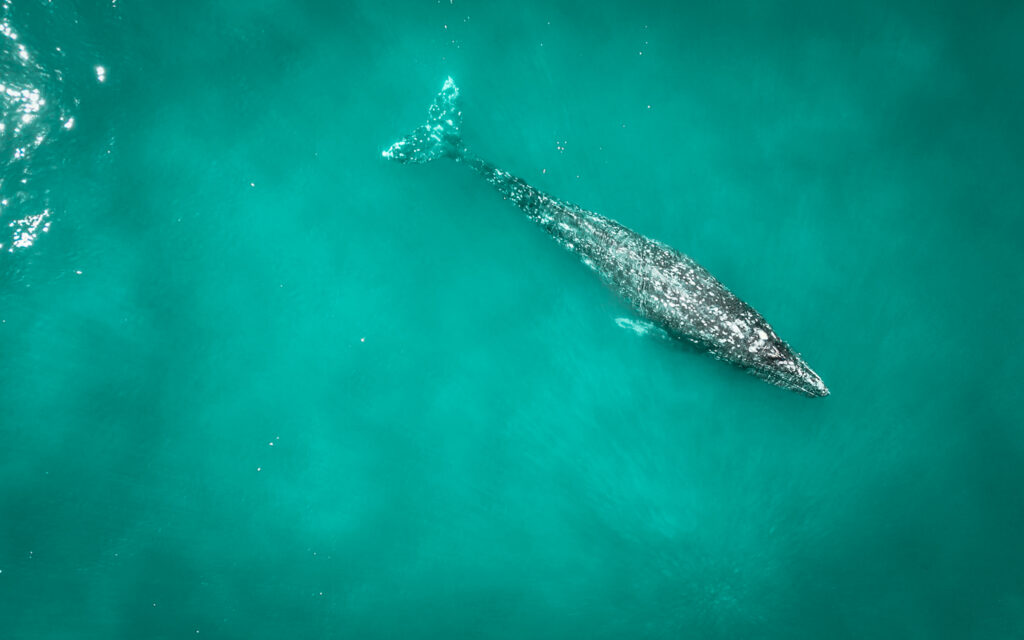
When we arrive in the region, only the last stragglers are left in the bay of La Almeja, mostly young males. The females with their calves are already on their way north for there is a long journey ahead of them. Grey whales have the longest migration route of any whale: they swim over 10 000 kilometres one way annually between Alaska and Mexico.
It is very quiet at this time of year. It might even be that we don’t see a single whale. In peak season, in February, up to 200 whales seek shelter in the shallow waters. Because out there, in deeper water, the slow-swimming grey whales – especially the calves – are at the mercy of the fast killer whales.
From hunted devil fish to cuddle monsters
However, the greatest enemy of the grey whale is and remains humans. They became extinct in the Atlantic around 1700; today, only the North Pacific population remains. And they too were on the brink of extinction until they were protected in 1947. Grey whales like to stay in coastal regions and are not fast swimmers, that means they are easy prey even for less talented whalers.
These whalers only had to watch out for the mother cows as the devil fish furiously attacked the whalers to protect their calves. Today, they are beloved whales, because they are known for approaching boats to let people scratch them. The reason for this remains unexplained.
For us, it’s a matter of waiting – and we’re unlikely to encounter any mothers anyway. Large schools of fish swarm just beneath the surface; birds wait for the right moment to strike. Then we see a small blow, and suddenly the pointed snout of a grey whale pops out of the water like a buoy.
Grey whales don’t breach spectacularly like humpbacks; they spyhop. In doing so, they push their head and upper body vertically out of the water, only to let themselves sink back down immediately. Almost like a forgotten message in a bottle in the swell – and then we are already heading back to land past beaches full of pelicans and cormoranes.
As slowly as the whales swim, this intimate encounter with a grey whale that seems to have forgotten time a little is over just as quickly.
The humpback whales that learn to leap
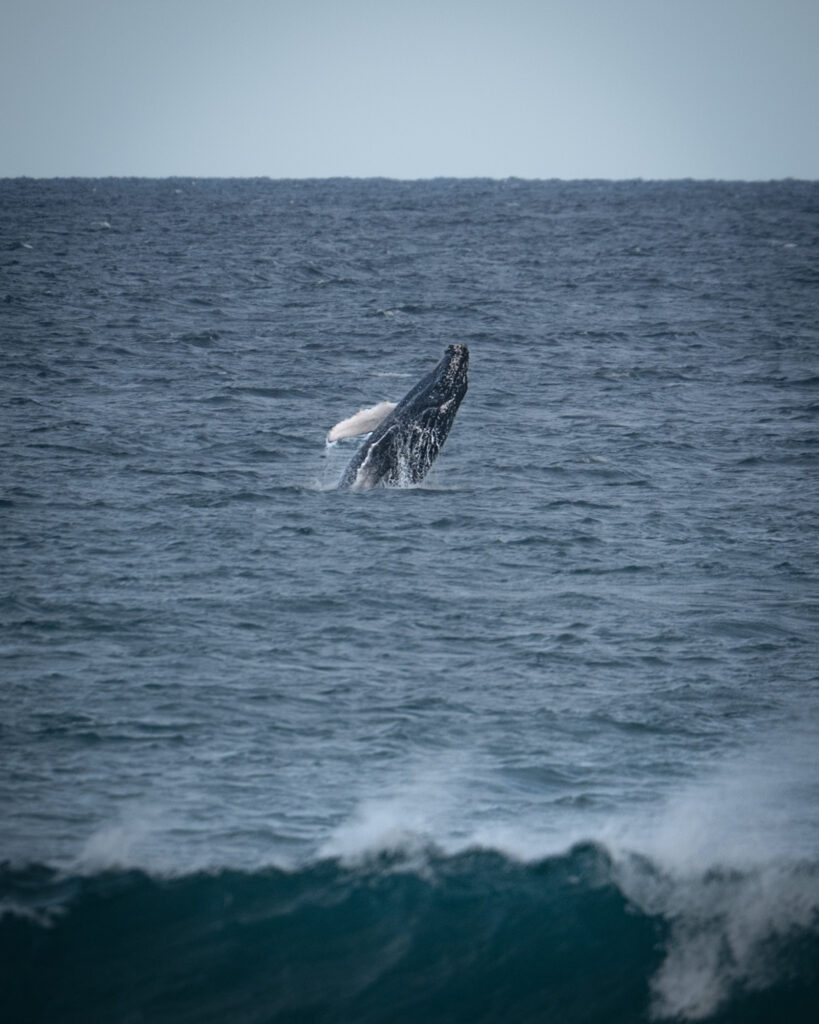
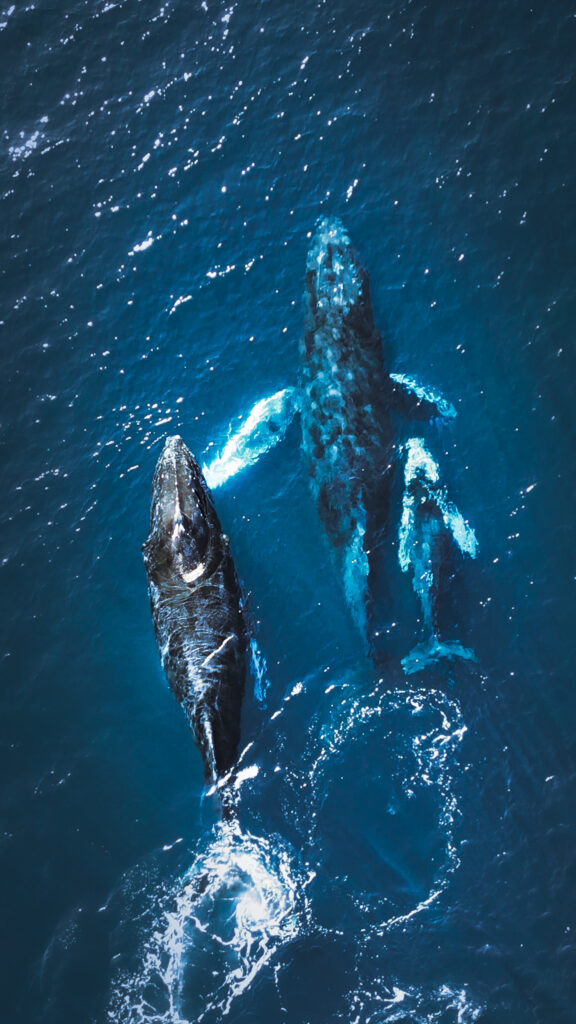
Meanwhile, the peak season for humpback whales is in full swing. Along the southern coast of Baja California, splashing and slapping hits the water from all sides. The young calves are learning to leap, and the adults have to show them how it’s done.
Humpback whales can be found in all the world’s oceans. We have encountered them in Central America before, but we didn’t experience a spectacle quite like the one in Baja California there. The days fly by – or disappear with the current – as we look out at the water, constantly keeping watch for the active giants.
The calves, barely five metres long, are still acting clumsily, while the mother, nearly three times their size, literally catapults herself out of the water. A splash that we can still hear a kilometre away on the beach. The exact reason for the whale breaches is unexplained; it could be against parasites, as play, or for communication. But if that isn’t loud enough, they slap their fins. Individual slaps with the pectoral fin or the fluke onto the water’s surface sound almost like a belly flop from a three-metre diving board.
A song without end
Once we’ve seen more than enough from the beach, we venture out onto the water by boat. Ideally, we would have paddled out directly on our own SUPs or something similar, but there was nothing to be found. And there it is again: mother and calf swimming peacefully along with the currents. Every now and then, a male joins them. Mostly, they are tolerated by the mother cows for protection against killer whales. Because orcas simply like young whale calves – their favourite part is the tongue.
Humpback whales are also present underwater. Albeit far enough away that they can’t be seen, they can certainly be heard. Thanks to a specially shaped larynx, humpback whales can reuse once-inhaled air over and over again to perform long songs. Yes, exactly, entire songs – even with recurring verses. And they learn them from an early age, so that the same population sings the same song – despite the annual adaptation of the hit.
The blue whale that is a bit skinny
Now we are only missing one single whale that is native to Cousteau’s famous aquarium of the world: the blue whale.
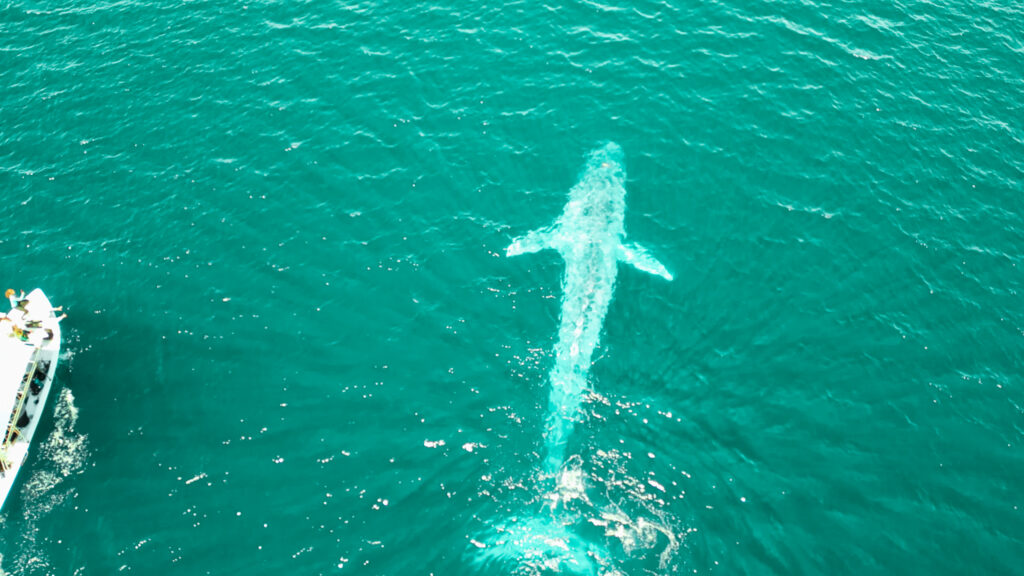
Our hopes of seeing the largest animal in the world are slim. The timid blue whales rarely breach out of the water. No wonder, it is no easy task to lift 150 tonnes out of the water either. However, our specimen probably doesn’t weigh anywhere near 150 tonnes.
The only blue whale we see from the boat seems to have very little on its ribs. Although blue whales possess a rather slender, streamlined body, you can clearly see the individual vertebrae pressing through on this one. And yet, it is impressive.
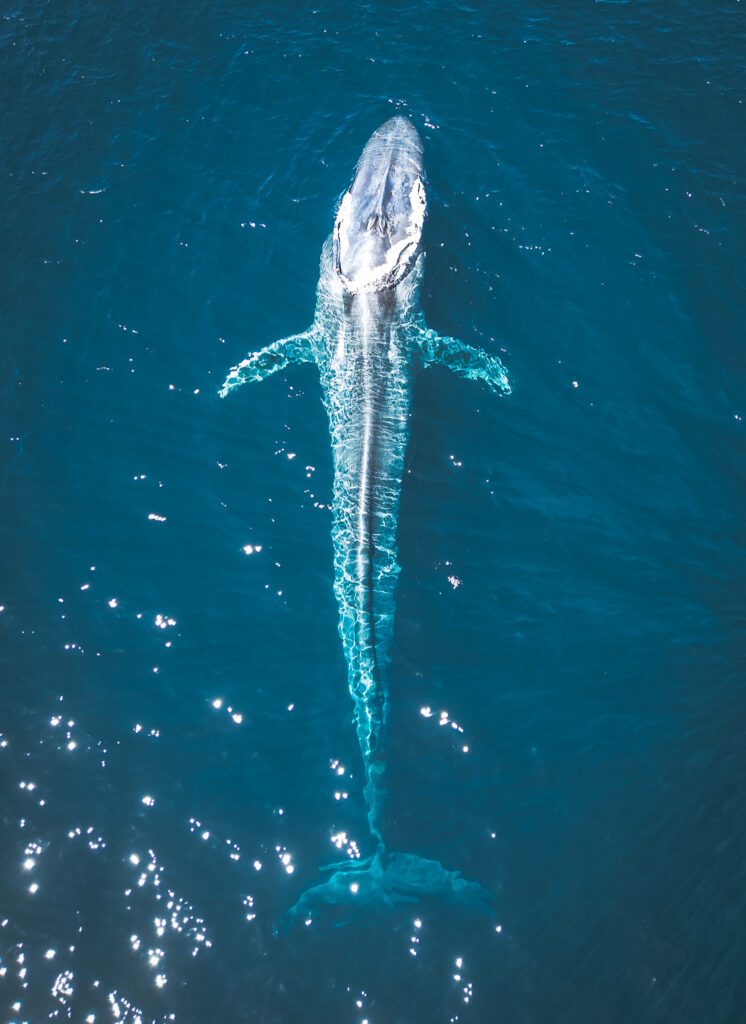
An immense, white ghost swims up out of the water. The snout breaks the surface, but the eyes remain beneath it. Its undulating movement brings the highest point, the blowhole, out of the water. The blow erupts like a fountain up to 12 metres into the air. And then it dives back down, not without displaying its entire spine. Finally, the fluke appears, larger than our boat, and the whale has vanished beneath the surface once more.
Our scrawny blue whale is three times as long as our small, roughly seven-metre boat, and twice as wide. Its heart is said to be like a Beetle car, its tongue weighs about 4 tonnes – even more than our fully packed Land Cruiser. Encountering a skinny specimen of the largest living creature to have ever existed on Earth leaves you feeling tiny nonetheless.
The clock that urges us to continue on
For hours – if not days – we gaze out into the water. The whales, dolphins, rays and fish, the sea lions and sea turtles, the seabirds and crabs provide the best entertainment. Boredom never strikes; it is only time that flies by in a whirlwind. The clock is ticking; it is time to move on.
It is with a heavy heart that we leave the beautiful beaches of southern Baja California. We set off in search of other giants, namely those from the world of plants. To do so, we must swap salt for dust. Fortunately, we know that at our destination, a plunge into the cold sea water awaits us once more.
More similar posts:
Whale season in Central America
First part about Baja California: Swimming with whale sharks