


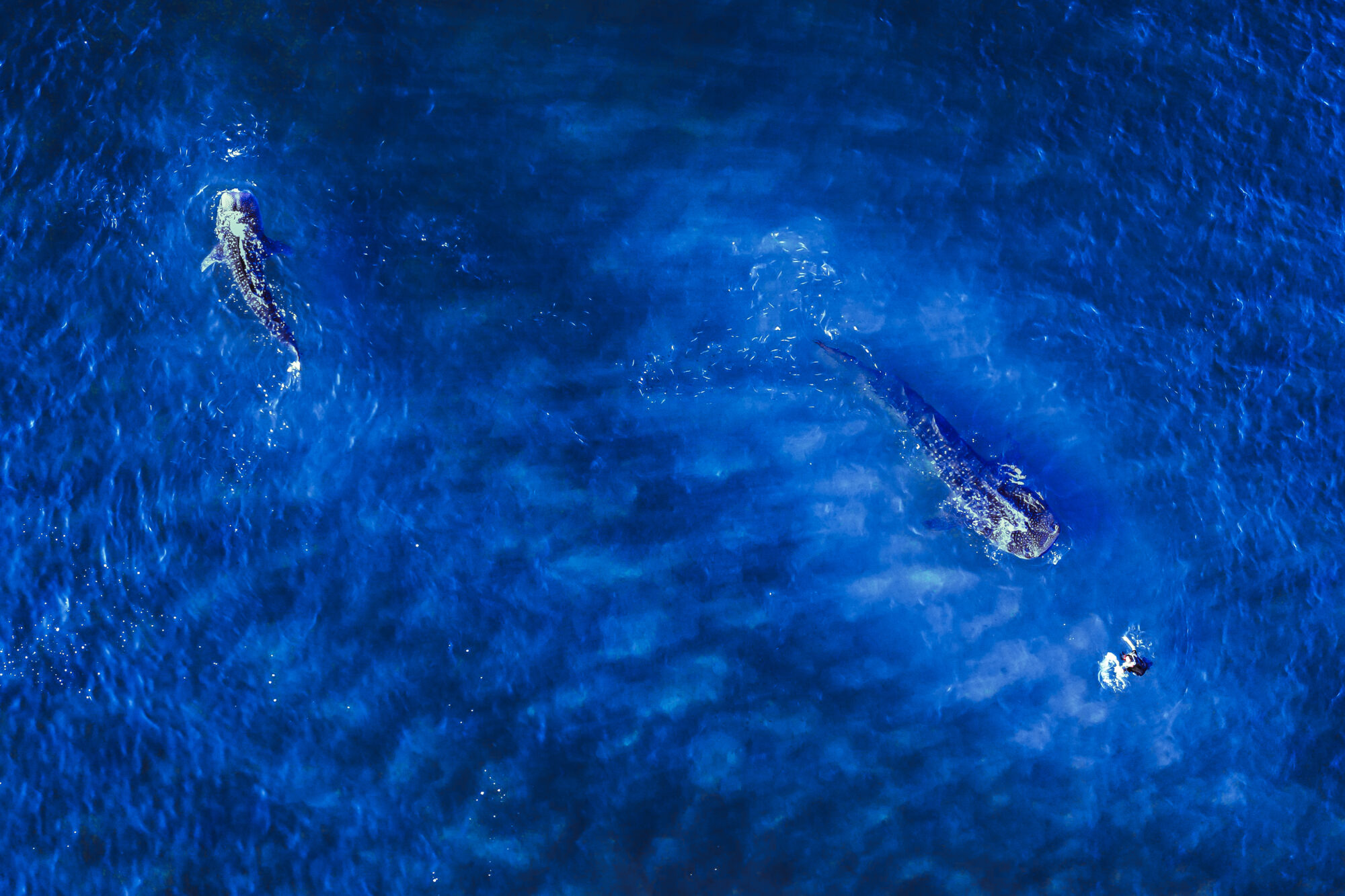
A blind date with a whale shark in murky water
The water is murky, barely two metres of visibility, the bottom sandy and littered with stingrays that you only spot at the very last second. The sea is shallow; you swim and swim, and the seabed barely seems to recede beneath you. Or perhaps it is just the poor visibility making everything appear monstrous. However, there is a reason for the murky water: it is extremely nutrient-rich and packed with plankton – the perfect food for the giants of the ocean.
Why do put yourself through this? Heading straight out into the open sea. Every now and then I look up through my snorkelling mask; the dorsal fin is still circling in the exact same spot. The direction is right – yet somehow, I am not getting any closer.
A second fin appears. The shark is doing its rounds; it is dinner time. A fleeting thought of the film Jaws crosses my mind. Swim on, quickly. The shark should have been directly ahead of me by now.
And then, hundreds of tiny fish arrive from all directions. They often use the giant as a protective shield or profit from its leftover food. And, oh horror, a window-sized mouth is heading straight for me! The whale shark is filtering tons of water as it swims forward – it has not seen me, and I certainly have not seen it. Whale sharks are harmless, I know that; I read it somewhere once. Although they possess thousands of tiny teeth, they do not use them for chewing at all, but filter their food through specialised gill rakers. Yet that massive, gaping mouth still makes me hesitate at first.
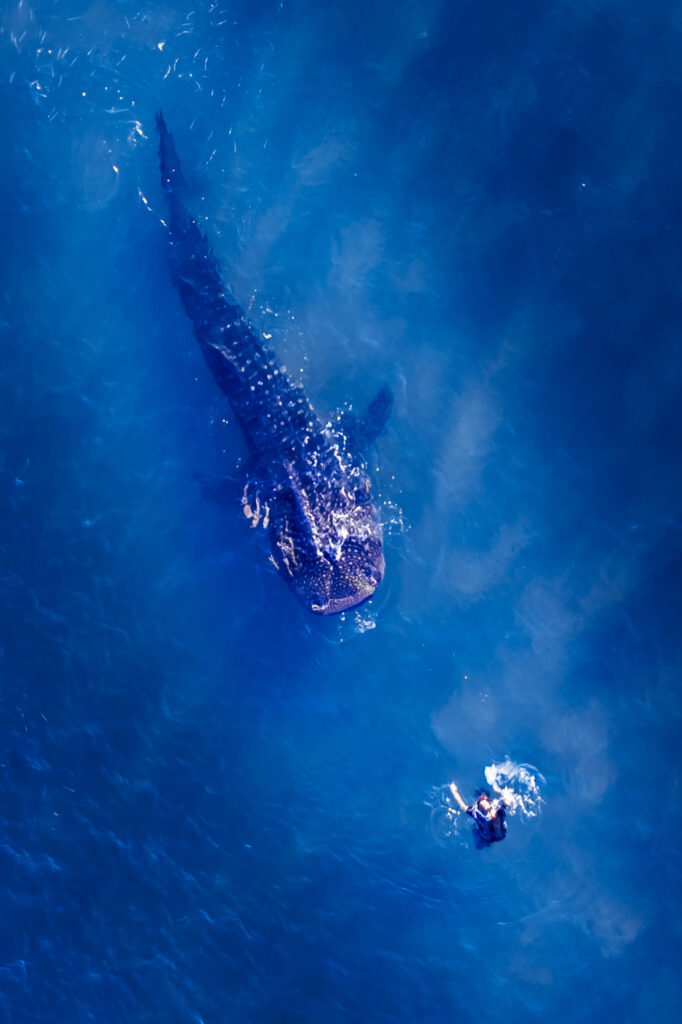
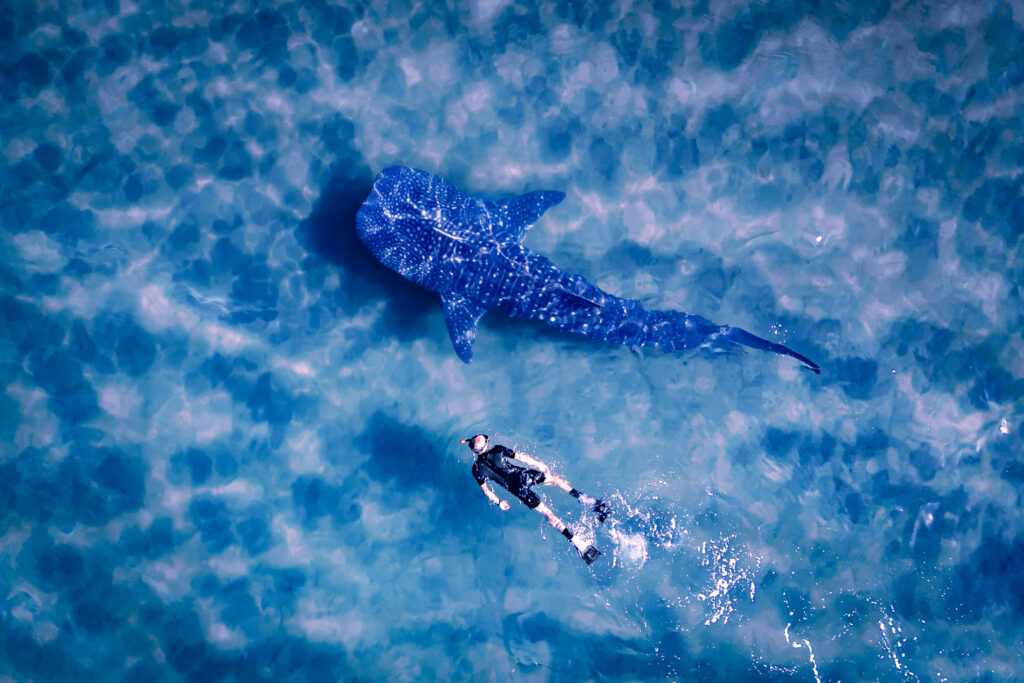
Then it simply swims past me. The first metre: leathery skin up to ten centimetres thick, speckled with bright little dots like water droplets. This pattern is as unique to each animal as a human fingerprint. Two, three, four metres. There fish still hasn’t passed me. Five, six, seven metres. The tail fin, as tall as a human, glides past me.
And just like that, the massive whale shark has vanished back into the murky sea. I swim after it, which requires a fair amount of stamina. Fortunately, I am wearing fins, otherwise I would hardly be able to keep up with its leisurely cruising speed of about 5 km/h.
The plancton kitchen of El Mogote
In Baja California, whale sharks come to the Bay of La Paz between October and April because the currents literally push the plankton right into it. You can barely see them from the shore. As sharks, they have gills and, unlike dolphins or whales, do not need to come to the surface to breathe. Yet the bay is full of these giants.
We meet a pair of biologists on the beach: they have already counted 24 individuals this morning. They are conducting studies on population size, and we watch them fly their drones. Because from the air, due to the altered angle of light, you can see the sharks crystal clear. Even the sea looks Caribbean blue from above – what an illusion.
Encountering the whale shark from the shore – no other tourists, no tour, nobody else on the beach – is unique. And one of the top five highlights of our trip. But here, too, it requires a lot of patience. We try several times. The first attempt fails. That is why we camp out in the dunes of El Mogote. We keep a lookout for hours, hoping they might come close enough to the shore after all. Third time is a charm, and so it was for us: on the third day, we finally see them!
Impossible to get enough of the views
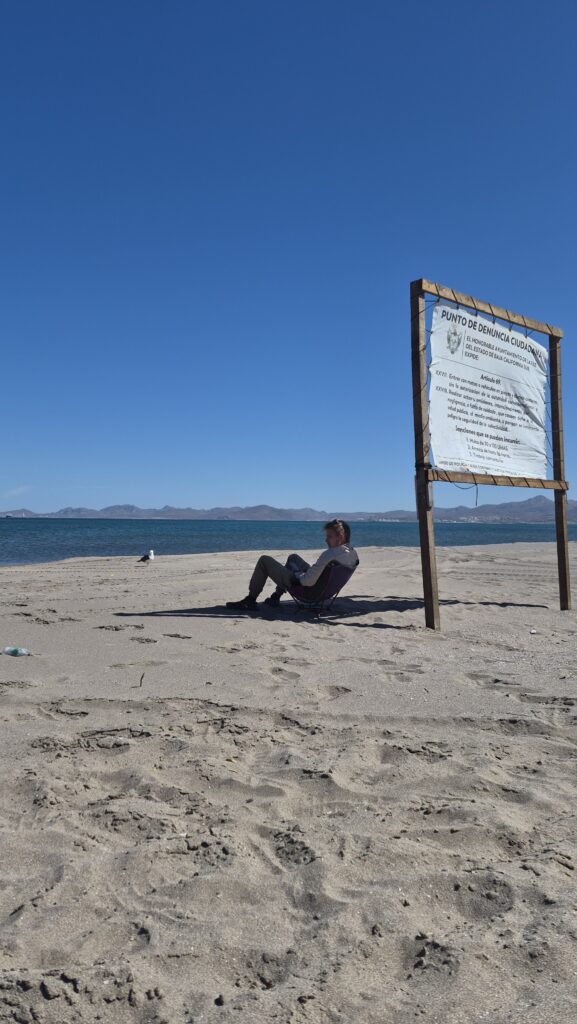
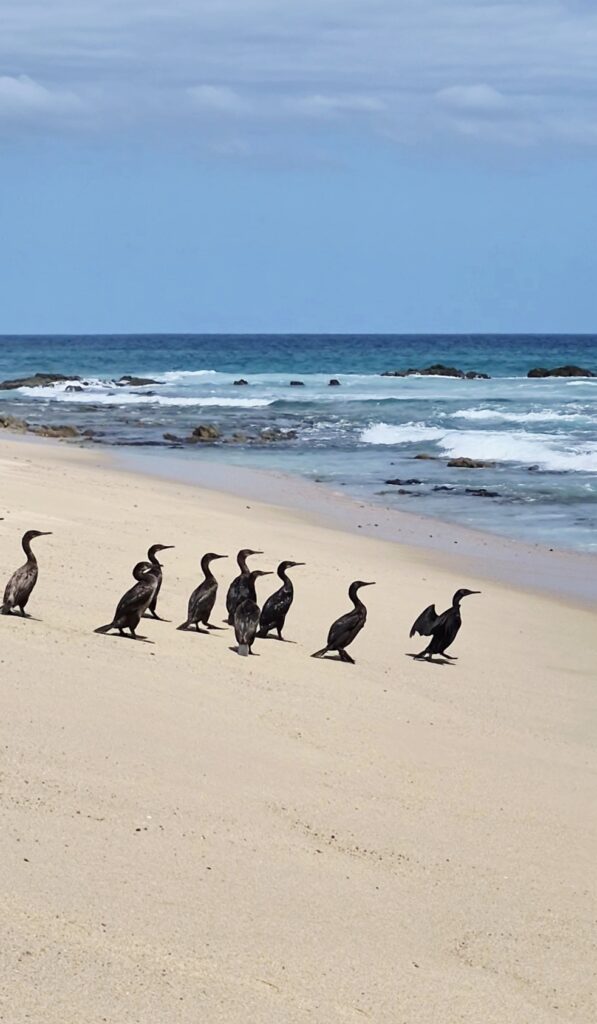

Baja California and especially the Sea of Cortez resemble a cold, gargantuan aquarium. We spend all day at a wide variety of beaches – even the annoying sand that constantly steals into the inside of the car is absolutely worth it.
We are constantly looking out at the water. You must not let yourself get distracted, because you regret it instantly. Right by the shore, pelicans and ospreys crash headfirst into the surface in a steep dive to grab their snack and immediately safeguard it from the gulls.
Out on the horizon, sometimes near, sometimes far, a humpback whale calf practises its first, rather clumsy breaches, while the mother right beside it elegantly demonstrates how it is done. No sooner has the whale submerged than dolphins leap past, and shortly before sunset, more and more mobula rays catapult themselves out of the water like skipping stones. In between, a sea lion pops up briefly or a sea turtle comes to the surface to breathe. You quite simply have no chance of getting enough of it.
Only in the evening, when everything is dark, does it seem the right time for a break. Until a loud splash on the water somewhere serves as a reminder: the whales are still swimming past.
The absolute madness beneath the surface

And if you do happen to get bored? Then it is time to get into the water! The spectacle continues seamlessly while snorkelling or diving. Suddenly, we have to manoeuvre our way through a veritable wall of pufferfish. Whichever way you look, those bulbous eyes are staring right at you. Even though they drift along peacefully, the sheer mass and their extremely powerful jaws give you a bit of a qualm.
Cornetfish, almost as large as a human, swim past inquisitively. While crabs and lobsters hide in the rocky crevices, eagle rays glide across the seabed. And, of course, there are the countless little reef fish defending their tiny territory with sheer vigour and bravery – especially against us humans. Or even a small reef shark that quickly makes a run for it. All of this directly from the shore.
The Sea of Cortez is teeming with life – and there would be so much more to discover, for which we unfortunately no longer had the time or resources. But we still have plenty to tell you about the whales. More on that in the next blog post!