

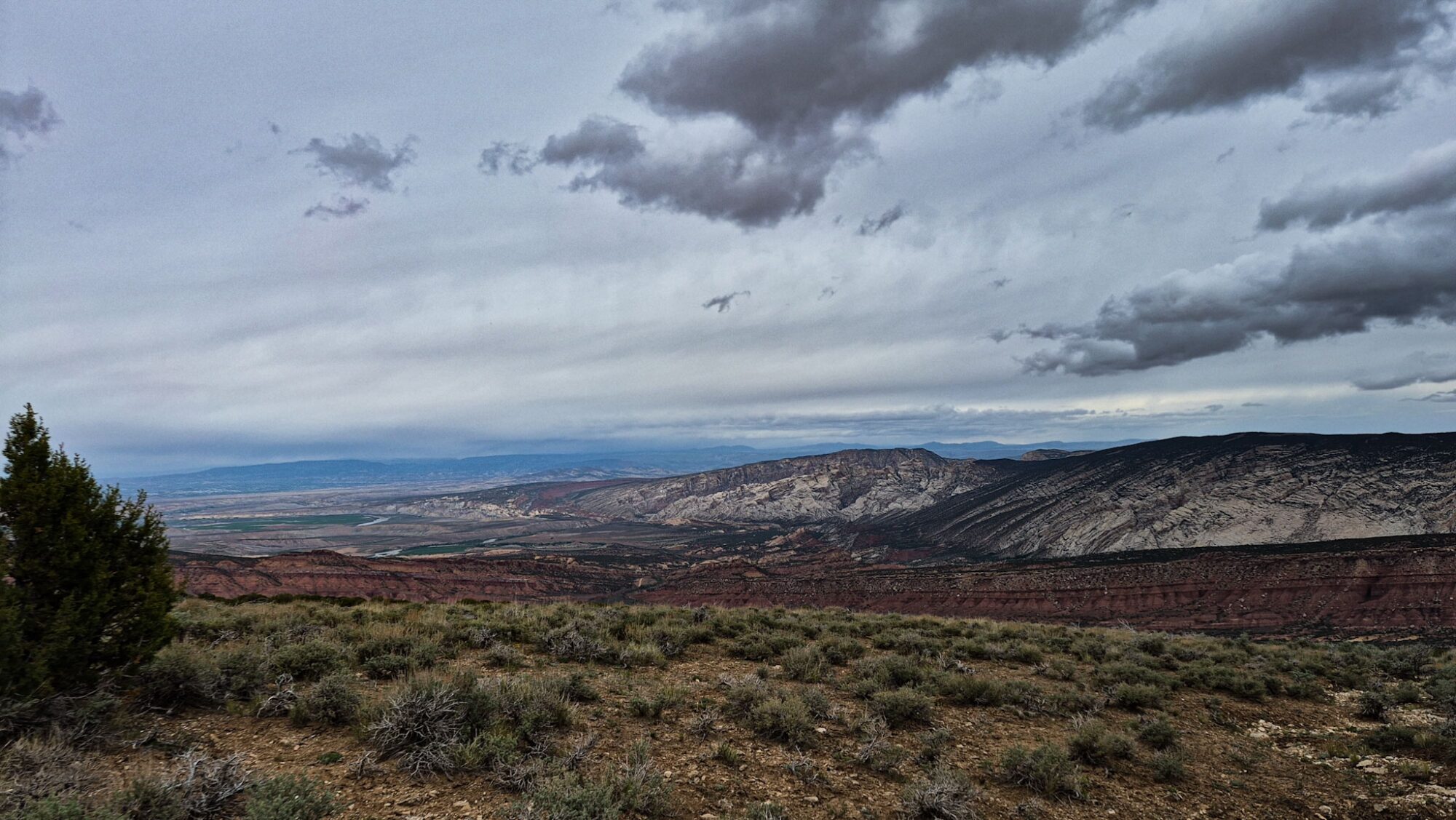
Our time travel through the layers of the Earth begins in the depths of the high-altitude desert. The high plateau in the US Midwest was once a tropical sea lined with ferns instead of palm trees. Today, only knee-high, dry scrub remains. The warmth that this area once radiated is almost unimaginable for a snowstorm is blowing past, forcing us into another cold night at the lowest point of the valley.
Yet, today’s barren desert landscape provides the perfect preservation for the remnants of the ancient dinosaur world. The exhibition at the Dinosaur National Monument is merely the most spectacular example, but there are numerous other treasures hidden in the stone throughout the entire surrounding area.
KM 0, 150 million years ago
The wall of bones
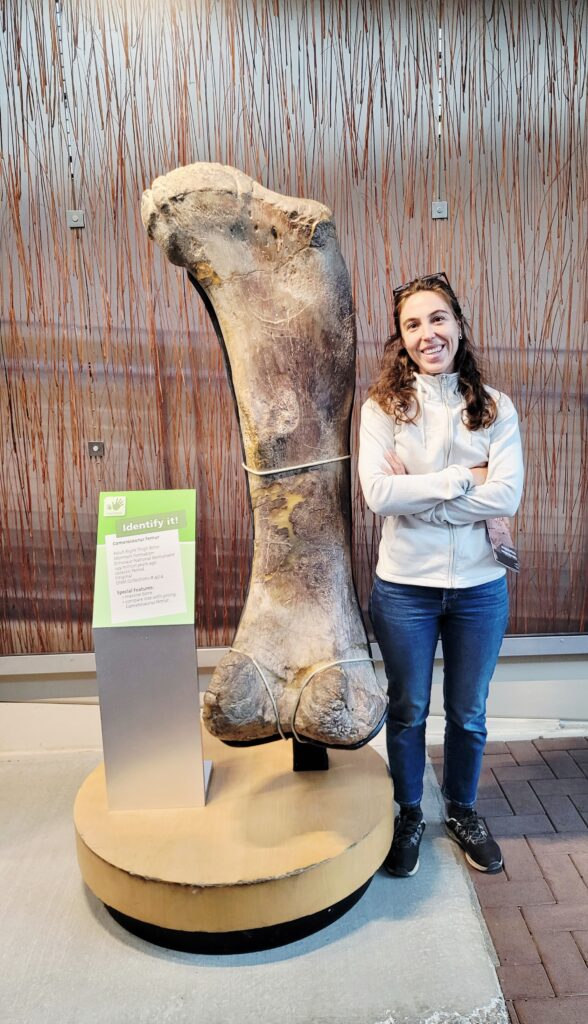
Cora stands next to the femur of a fully grown Camarasaurus: it’s bigger than her . The spinal vertebrae protrude from the stone wall next to it—still all vertebrae in a row, admittedly, but no longer quite in their correct position. The wall, containing 1500 fossils from the Morrison Formation, is 24 metres long and about 8 metres high—and that is only the part they have deliberately left raw. Researchers are constantly finding new dinosaurs in the Dinosaur National Monument, mostly entire skeletons. They hardly dare to expand a car park, because the probability is high that more bones lie exactly beneath it.
You would almost think that the dinosaur bones are simply lying out in the open everywhere, and that you could trip over them at any moment. While the truth is a little more complicated, the idea is not entirely far-fetched.
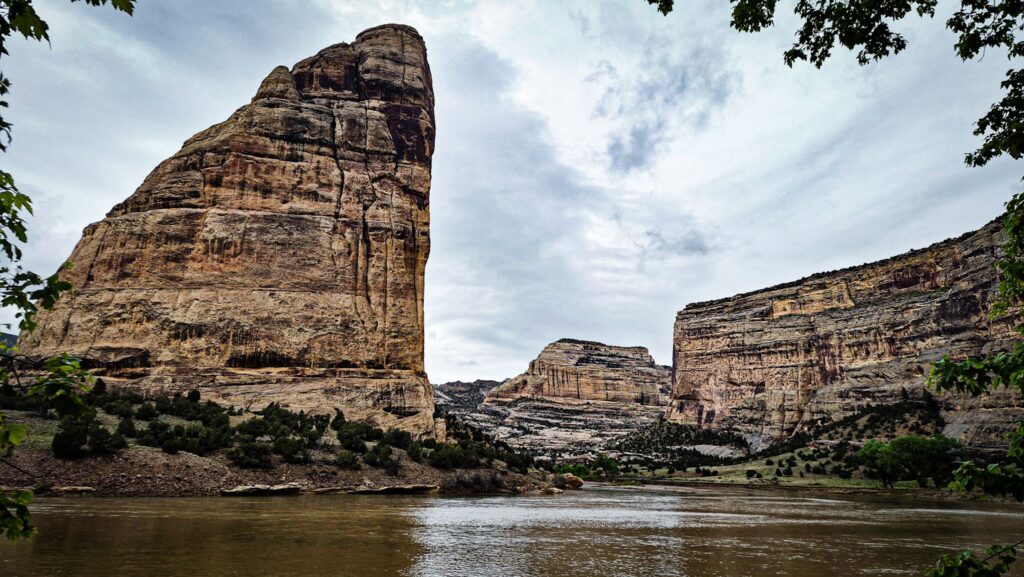
The area known as the Morrison Formation was criss-crossed by a large river. During droughts, the animals came closer to the water, and when they died, they were covered with sand and mud as the water level rose. Starting about 65 million years ago, tectonic shifts pushed the entire slab upwards; since then, the wall has stood at an angle of 67 degrees. The bones that lay on the upper edge thus gradually came to light through erosion—and became discoverable in the first place.
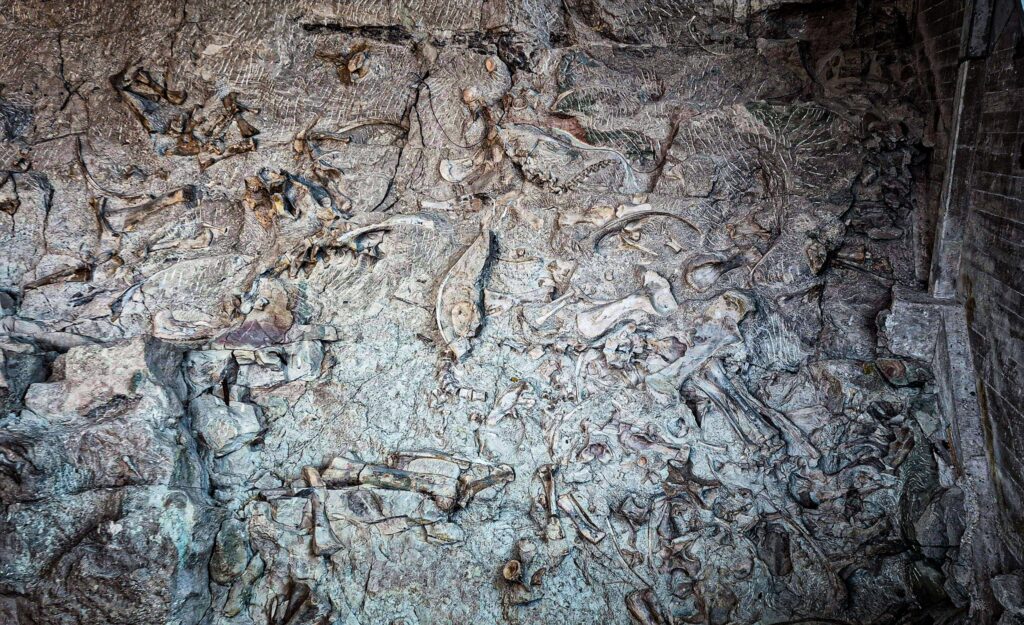
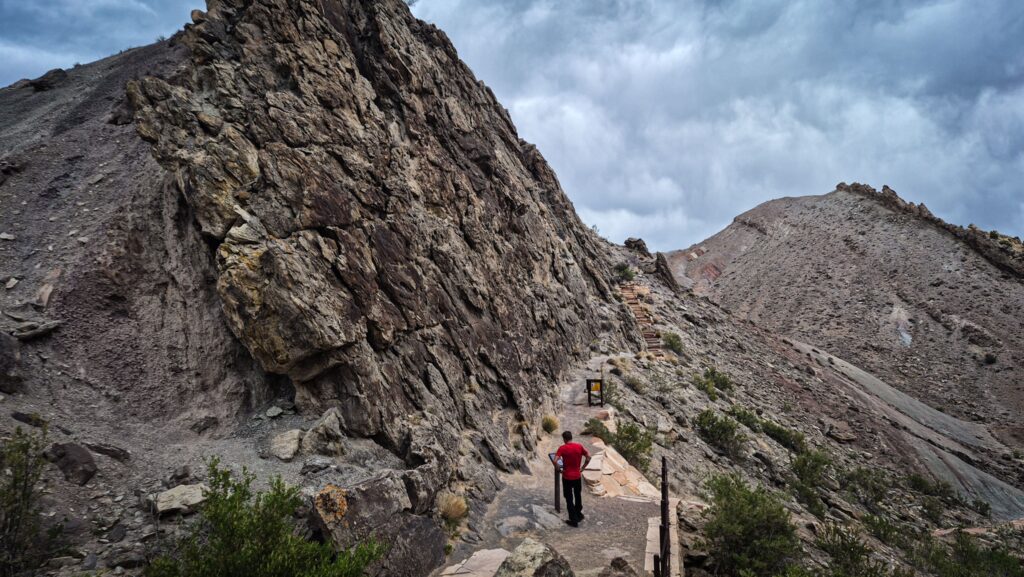
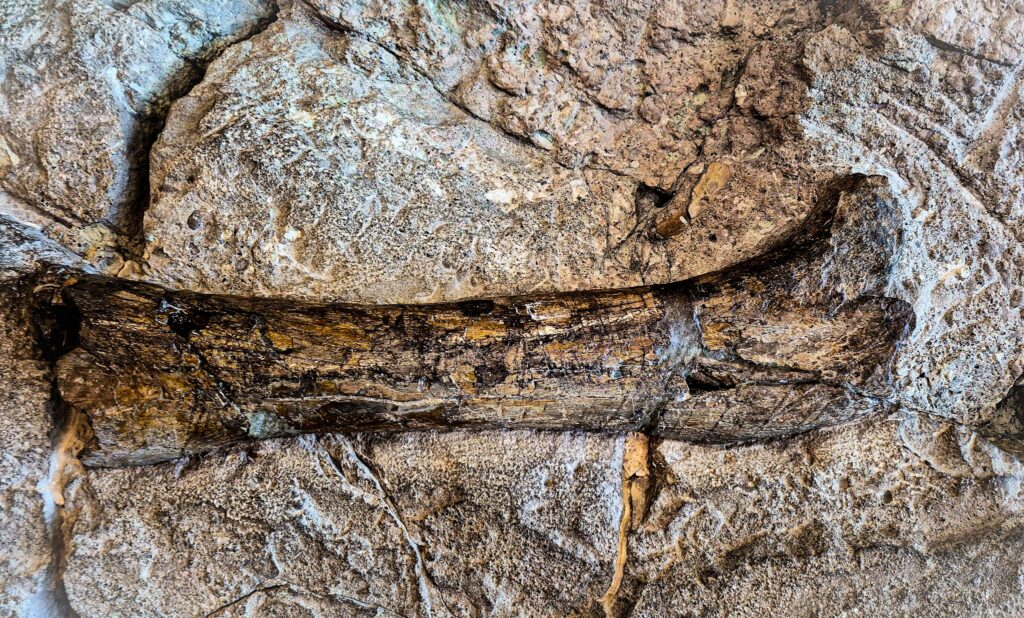
The quarries in the midwestern states of the USA are steeped in history. Because the region had shallow seas and plenty of shale, limestone, and sandstone, the fossils were well preserved over centuries. Added to this, as the North American continent was forming, plates collided and pushed the Rocky Mountains upwards. This tilted all the layers up and brought them closer to the surface.
After the snowstorm that hits Colorado in mid-May, we emerge from the valley of the dinosaurs and set out on a search of our own. Not for dinosaur bones—as that isn’t allowed to keep—but plants can turn to stone too, after all.
With that, we leave the Jurassic period behind and dive—or rather dig our way—into the Eocene.
KM 450, 50 million years ago
Digging trenches in the ancient Lake Gosiute
Fifty million years ago, the area in what is now southern Wyoming lay in a huge lake, Lake Gosiute. Back then, trees grew along the shore; today, they lie preserved as petrified wood not deep beneath the sand. We dig our way through the ground in the Blue Forest.
Here too, we find ourselves today in the middle of a high desert. The drought-resistant sagebrush grows abundantly; in between lies sand and, every now and then, a river lined with poplars.
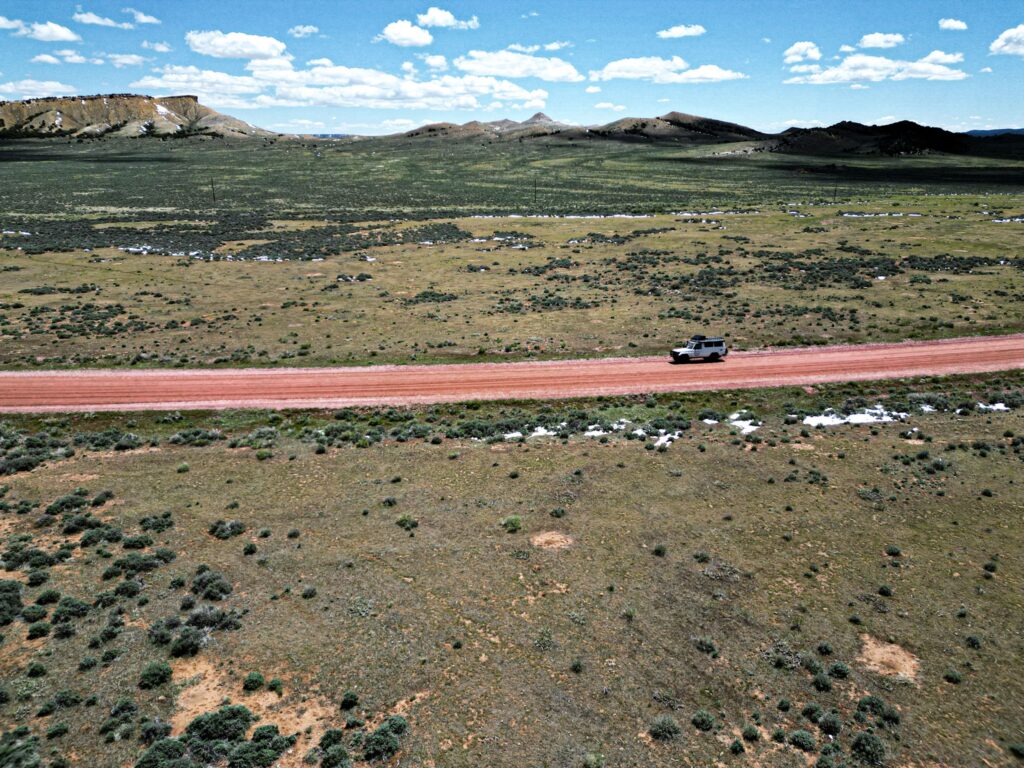
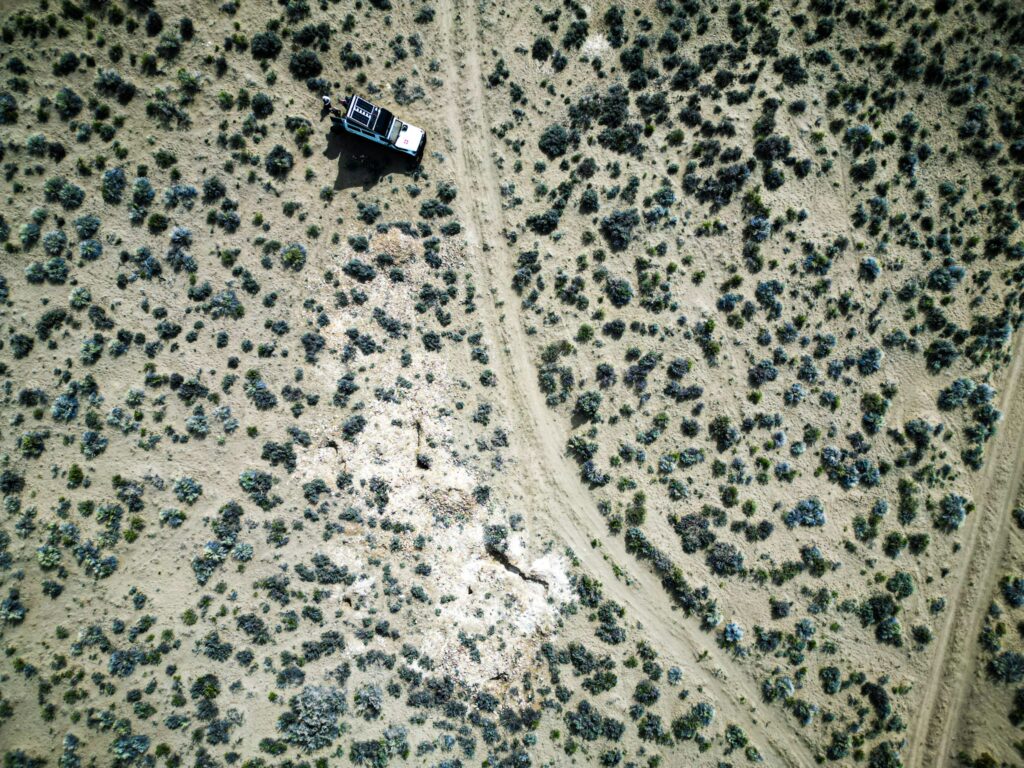
We make ourselves comfortable among the oil derricks and the countless holes left by previous searchers. It is public land, and at this spot in Wyoming, it is permitted to search for the wood. However, you are not allowed to use machinery; everything has to be dug up and chipped out the old-fashioned way with a shovel, hammer, and chisel.
We walk around, look at the existing holes, and enlarge one of them; perhaps there are still remnants left. After a while, we look around again and lo and behold: a petrified tree trunk protrudes from a hole one metre deep. It seems the predecessor did not take everything.
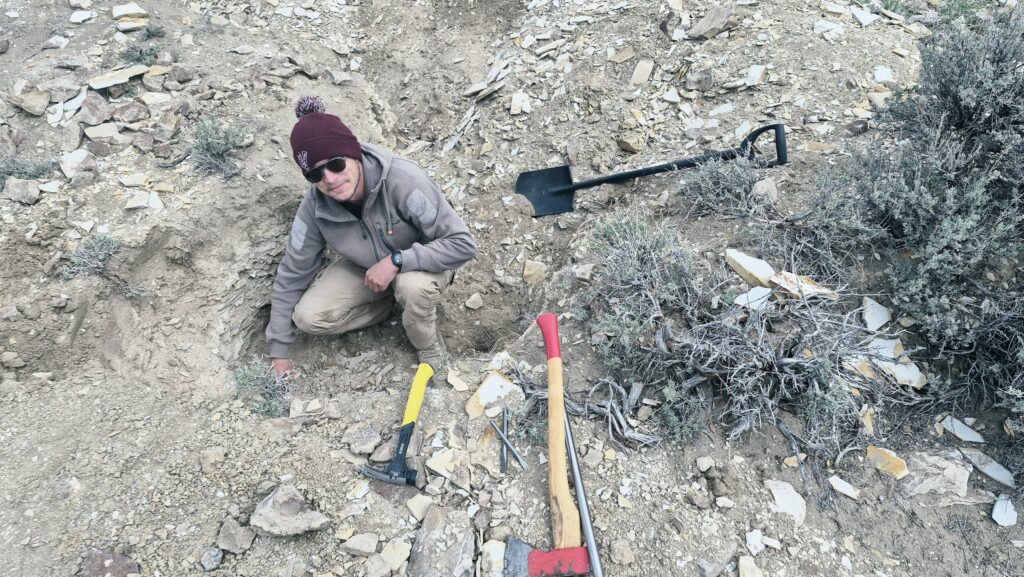
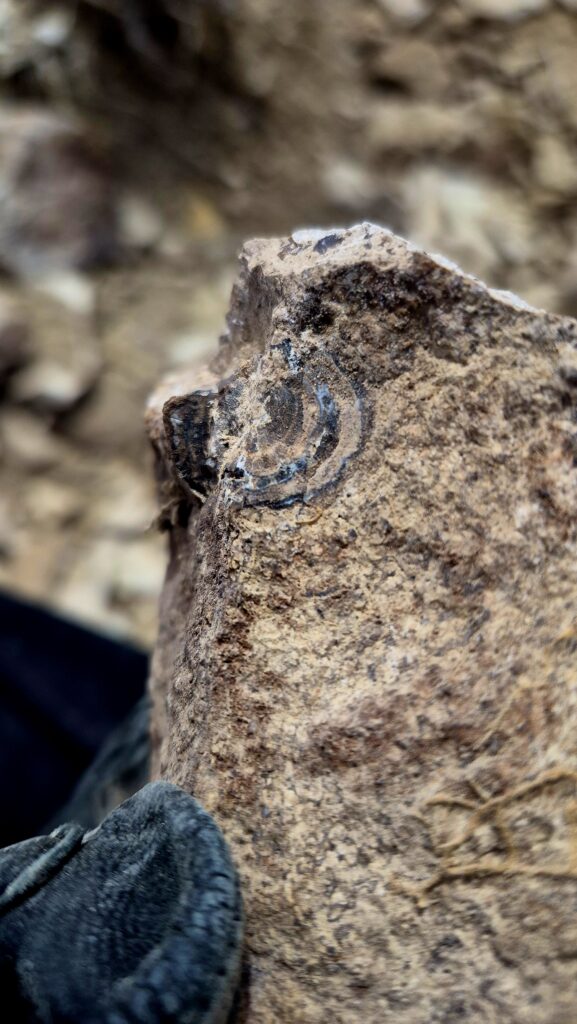
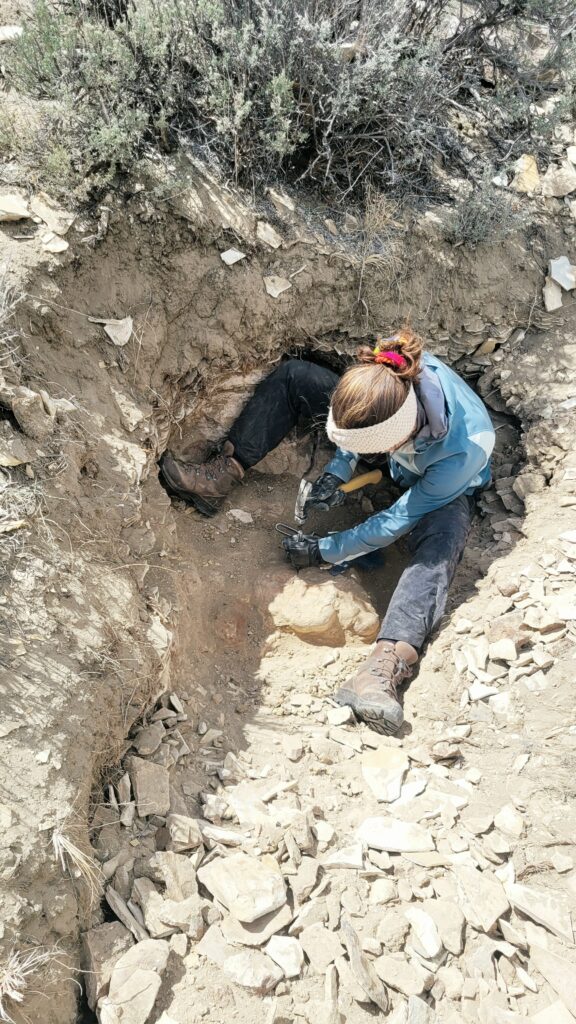
Petrified wood is also a fossil. Many trees around Lake Gosiute fell into the water and were airtightly covered by mud, sand, and other sediments. Water continues to seep through the ground, transporting minerals. These also flow through the tree trunk, with a portion getting caught in the wood. Because the process is so slow, the inorganic material—that is, the minerals—’takes over’ the structure of the organic wood it replaces. Thus, the shape of the tree trunk is preserved and coloured by the minerals.
In the Blue Forest, the wood likes to shimmer blue, hence the name. The colour comes from the agate and chalcedon that enclosed the wood. And we are in luck—we manage to get a few beautiful pieces out. Now we are simply carrying a few extra kilos of stone in the car still wondering what exactly becomes of it.
Apparently, some people also find fossils of vertebrates. However, unlike fossilised insects, it is forbidden to take these away. We do not find any either, though we do not want to miss the chance to see a few for ourselves.
KM 550, also 50 million years ago
The flatten animals and plants
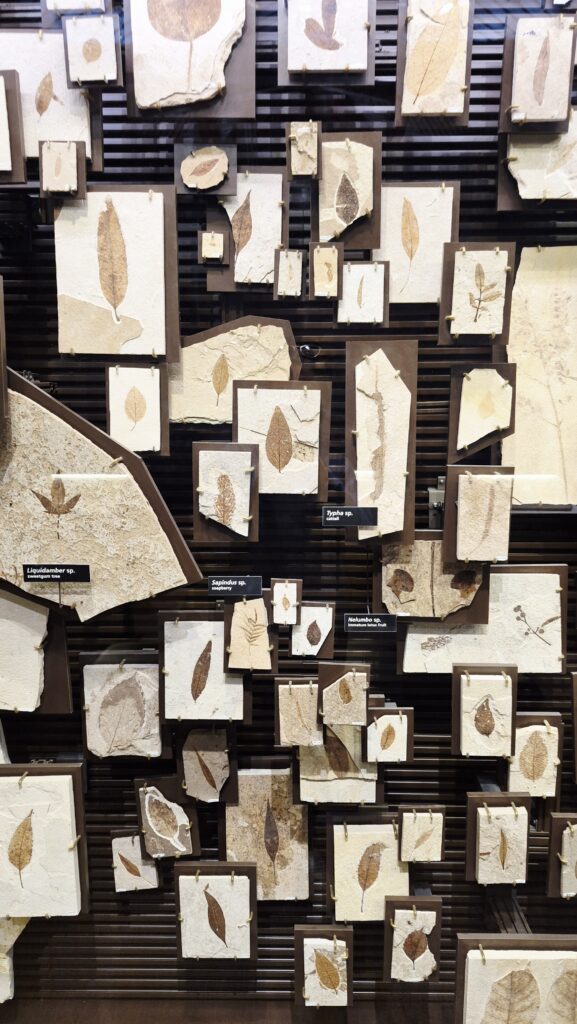
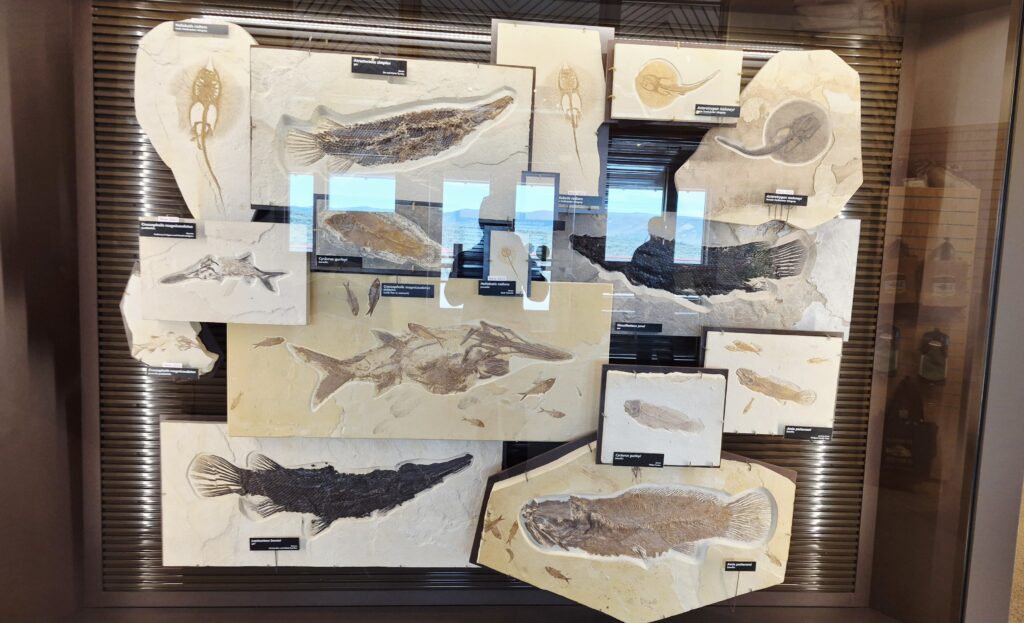
Once all the dust has been brushed off our clothes and the shower has washed the rest from our bodies, we head off to the Fossil Butte National Monument. To the place where crocodiles swam in Fossil Lake 50 million years ago.
The surrounding area is famous for flawlessly preserved fossils of plants, insects, fish, and reptiles. Every now and then, even a mammal.
Fossil Lake was a meromictic lake; so the water layers never mixed. The bottom was extremely salty, which prevented organic decay. The freshwater animals living in the lake were therefore unable to eat the dead animals lying in the salt layer. Additionally, the bottom was low in oxygen and a thick microbiotic algal mat grew. Thanks to the cyanobacteria, the dead animals were quickly enclosed by the mats and shielded from the light. Thus, the perfect conditions for fossils were created.
Furthermore, limestone settled on top of it like a heavy blanket—layer by layer—and preserved the fossils exactly as they had died.
Today, brittle, smooth clay slabs with remarkable remains can be found throughout the area. In the Fossil Butte National Monument, the finds are protected and can be admired in the small visitor centre. Next door, there are private quarries that lease their land for searching. This means you pay a fee and can then search for a couple of hours and keep everything you find—unless the value is immensely high.
We save ourselves this expensive bit of fun. After all, we still have all that petrified wood, where firstly, we do not know what to do with it, and secondly, we do not know where to store it yet either.
As a side note: according to alternative medicine, petrified wood gives strength and helps with weight loss. Unfortunately, we have not noticed the effect yet; the car weighs more and more, and it seems to need more fuel rather than less. However, we are not giving up hope.