


A small stream winds its way under the bridge, losing itself in the stony, rugged terrain. A simple archway marks the entrance to the recreation area. The ticket booth – a small, rather dilapidated hut – looks deserted. Although the price is posted (5 pesos per person), there is no one in sight to collect the money.
The only neighbour in sight seems to be driving away. I manage to flag her down. ‘The owners are at a party and won’t be back until tomorrow,’ she explains. She adds that it should be absolutely fine if we just stay. Is this our free pass for an overnight stay?
Despite the nearby main road – the only thoroughfare through this area – the spot feels idyllic. Conifers and oaks frame the meadow, and the stream babbles over the rocks with such consistency that small, natural pools have formed over time. There are fire pits and benches.
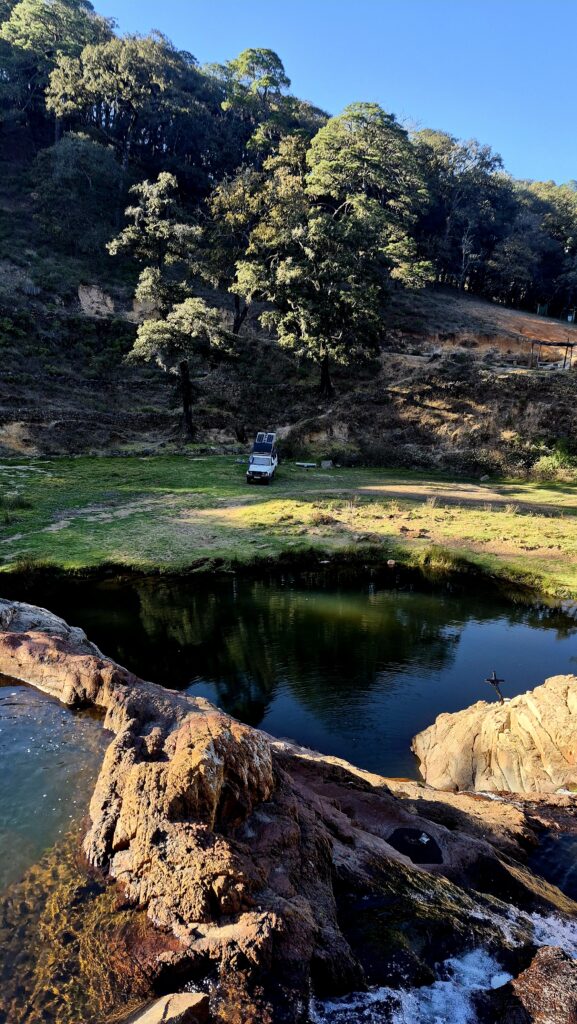
The unrest overshadowing some other parts of Mexico at this time feels miles away. Tourism even more so: no one seems to wander down here – at least, no foreigners. Accordingly, prices are low. But what has really brought us here is the search for a very special creature: a salamander that never grows up. A being that, biologically speaking, remains eternally young. The axolotl.
A scientific marvel
The axolotl (Ambystoma mexicanum) is a biological curiosity. It is endemic to Mexico, occurring only there – specifically in the canals of Xochimilco near Mexico City. However, encroaching urbanisation is the greatest threat to these animals. In the wild, the true axolotl is considered virtually extinct. According to the IUCN Red List, the population of this mole salamander is estimated at just 50 to 1000 individuals.
In captivity, the numbers tell a different story: depending on the source, it is estimated that there are tens of thousands to a million individuals kept as pets or in laboratories.
For science, the axolotl is of invaluable worth. Alongside reaching sexual maturity despite a lack of metamorphosis, it also possesses an extraordinary ability to regenerate: it can completely regrow not only limbs, but even parts of the heart, spine, and the brain, making them fully functional once more.
Black or pink? A question of adaptation
In popular culture, axolotls are mostly known as almost cartoon-like, pinkish-white creatures with a distinctive crown of gill stalks. However, these leucistic (white) forms stem almost exclusively from captive breeding. A lack of pigmentation is a death sentence in the wild. Wild individuals are usually dark brown, grey, or mottled black – the perfect camouflage for the muddy lakebed.
We knew that we were highly unlikely to find the extremely rare Ambystoma mexicanum here. Yet the mole salamander family has other fascinating members. In Mexico, the word axolote is often used as a general term for salamanders that remain in their larval stage. Many of these species possess the ability of neoteny: they reach sexual maturity without ever shedding their larval form (gills included).
One such species is the plateau tiger salamander (Ambystoma velascii).
Metamorphosis on demand
In the larval stage, the true axolotl and the tiger salamander are barely distinguishable. This often leads to wild-caught A. velascii being mistakenly sold as axolotls. The surprise usually follows in the aquarium: while the true axolotl almost always remains a “child”, the tiger salamander undergoes a complete metamorphosis as soon as conditions (such as water levels or temperature) change. It loses its gills, develops lungs, and leaves the water as a terrestrial salamander.
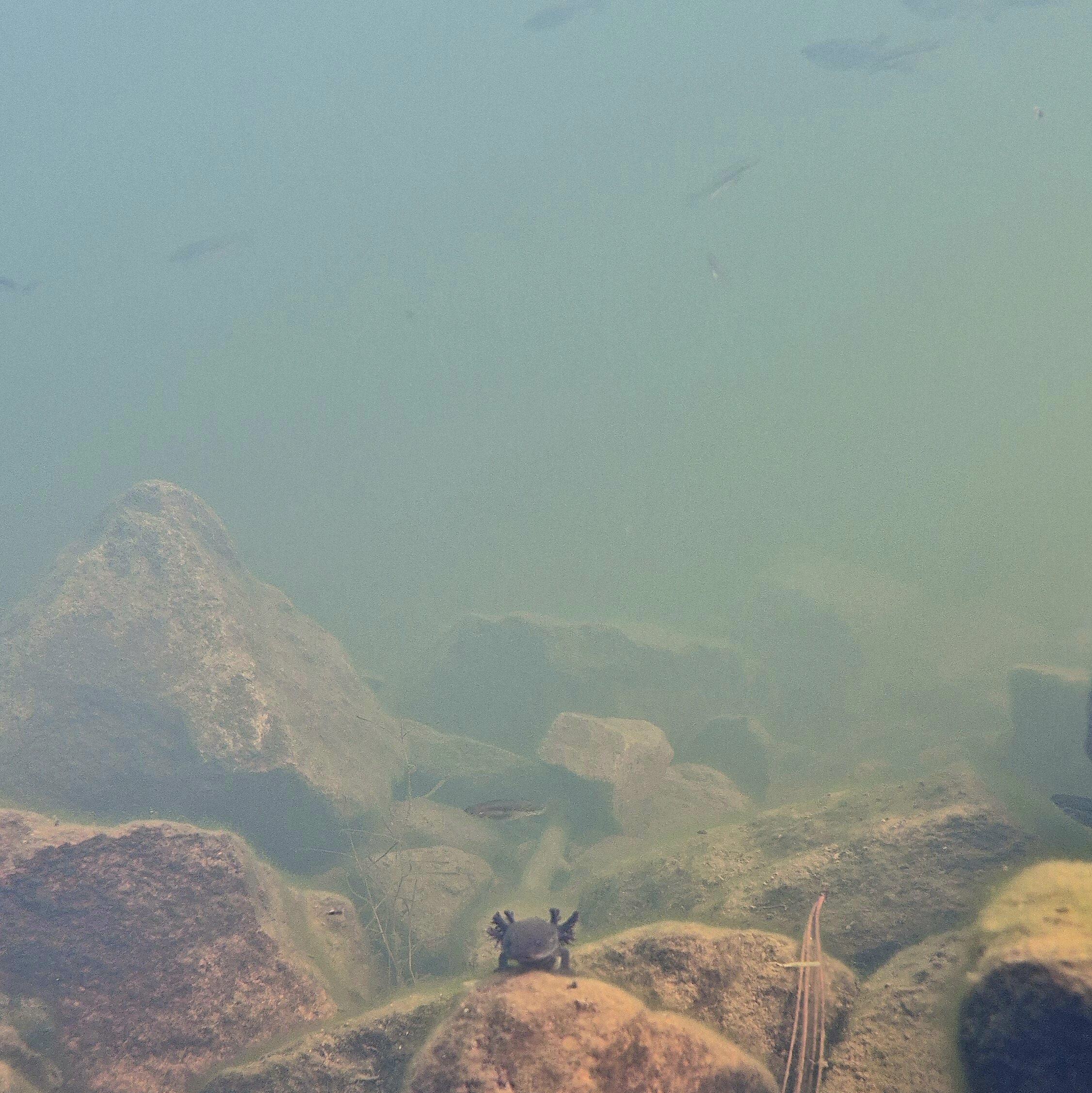
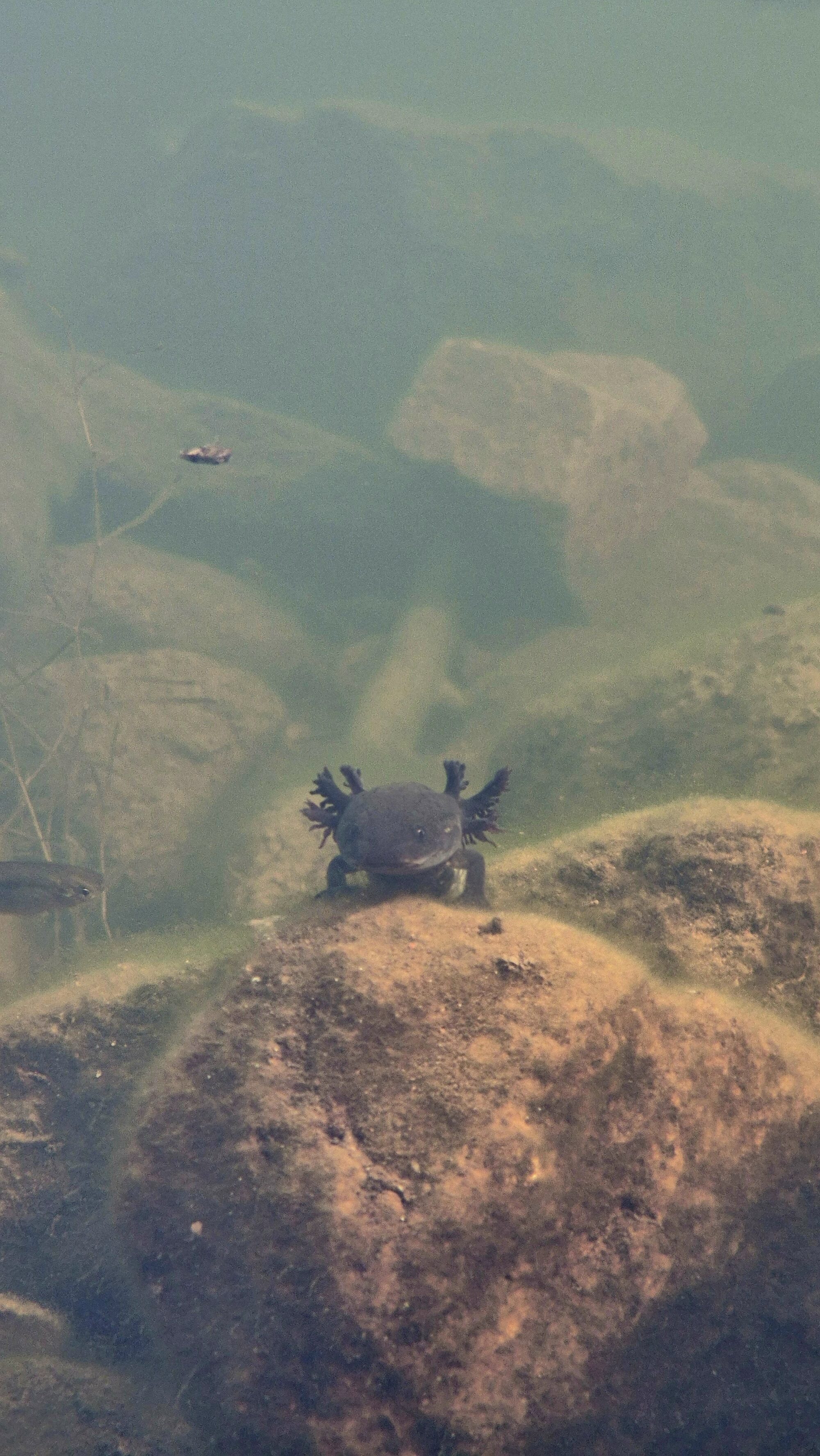
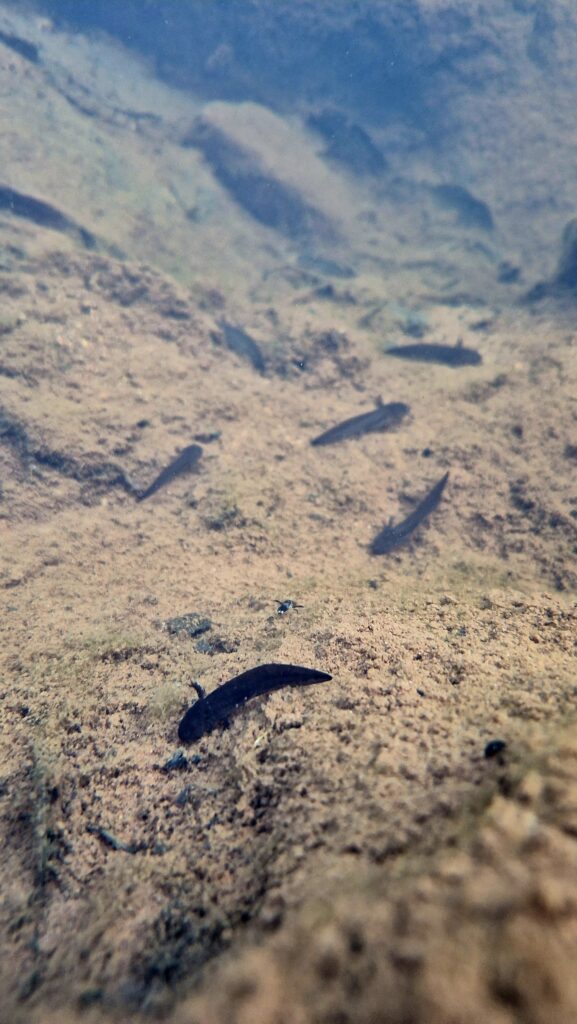
In the river system where we ended up, however, they apparently remain in the water for life. This usually happens at higher altitudes when they grow up in a body of water free from predatory fish. And that is exactly where we finally find them: tiny, dragon-like creatures with four legs and the characteristic crown of gills. It takes a while before we spot the first specimen in the somewhat murky water, but then we see them everywhere – in all sizes, completely undisturbed in their idyllic world.
When we drive past the ticket booth the next morning to pay, we are met with astonished glances. The owners hadn’t even noticed that anyone had been camping down by the river. To them, the axolotes are simply neighbours in the stream – to us, it was an encounter with yet another wonder of nature.