


‘They check everything,’ other travellers told us, so we braced ourselves for a tough, lengthy border crossing. We continued our way north: from Costa Rica to Nicaragua.
But our experience was the exact opposite: it had been a long time since crossing a border had been so quick. It took a whole 15 minutes in Costa Rica and an hour in Nicaragua, and in the end, no one wanted to search the car. We were apparently really lucky with the official – or perhaps hunger drove her to take her lunch break on time.
We were curious about Nicaragua anyway, because many travellers drive straight through – which, incidentally, is not as quick as you might think – or they don’t have much positive to say about the country. The terms ‘police checks’ and ‘corruption’ usually come up immediately in conversation.
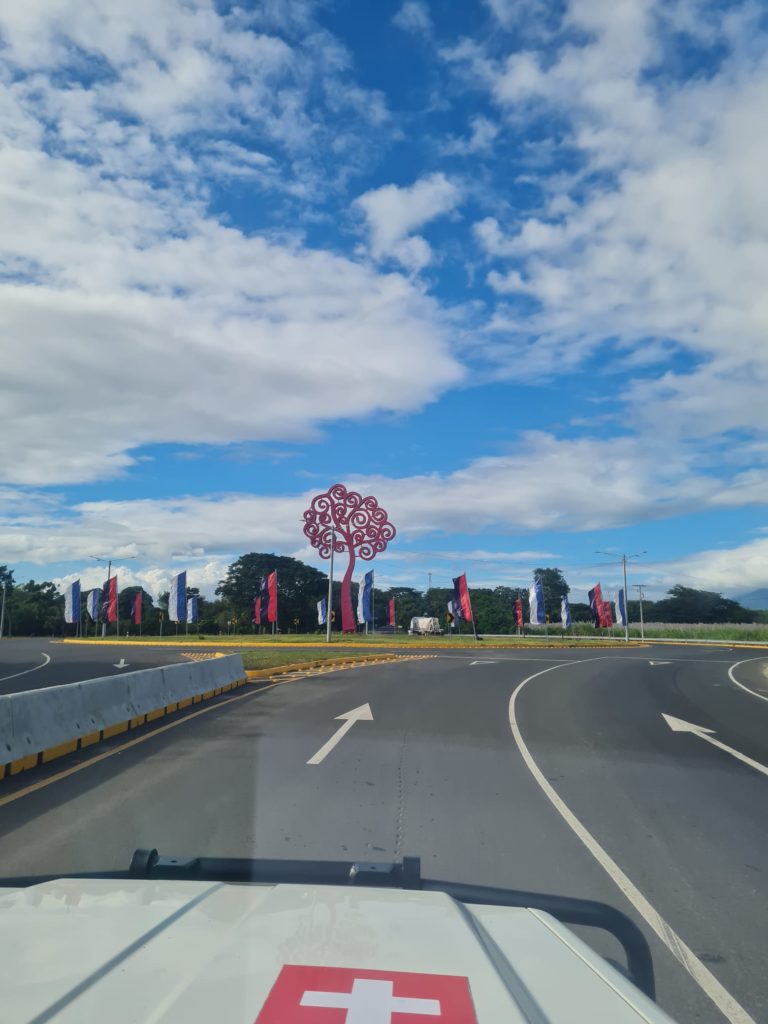
We were all the more surprised when we left the bumpy roads of Costa Rica behind us and suddenly found ourselves on a perfectly paved motorway. A sign at the side indicated 80 km/h. That made us wonder: hadn’t the customs officer just explained that there was a strict 50 km/h speed limit throughout the country?
We dared to drive faster anyway, after all, there is a sign. At some point, on the beautiful, fast road, an oncoming car warns us by flashing its headlights. A typical sign that there is some kind of obstacle ahead.
Shortly afterwards, the police were indeed standing at the side of the road using a laser speed gun. They let us pass, as we weren’t driving too fast: only 50 km/h. Although the section of road is signposted at 80 km/h.
This bothered us, so we did some research on the internet:
In June 2025, the government limited the speed limit nationwide to 50 km/h, but without removing the old signs. They remain on the side of the road, obsolete and confusing for all foreign drivers.
The aim of the new regulations is to reduce the number of road deaths, which at first glance seems to be working, given the figures for 2025 – around 900 compared to over 1000 in 2023. However, as in the rest of Latin America, fatal road accidents continue to be an everyday occurrence. This is because the cause of many accidents is not necessarily speed, but failure to maintain a safe distance, dangerous overtaking manoeuvres, motorcyclists not wearing helmets, poorly maintained vehicles and therefore poor brakes, and, of course, ignorance – or lack of knowledge – of traffic rules. It’s actually a miracle that no one has rear-ended us yet. So drivers are not driving more slowly, but they are now warning each other.
The speed limit may be well-intentioned, but its implementation clearly shows how Nicaragua works: a system perfectly designed for corruption.
The fact that the country ranked 172nd on the Corruption Perception Index in 2024 is evident at every turn. Since Daniel Ortega returned to power in 2006, corruption has risen steadily, and the new rules give the police another tool at their disposal. Most of the people we spoke to opt for a direct ‘deal’ during checks to avoid bureaucratic hassle – or even going straight to prison.
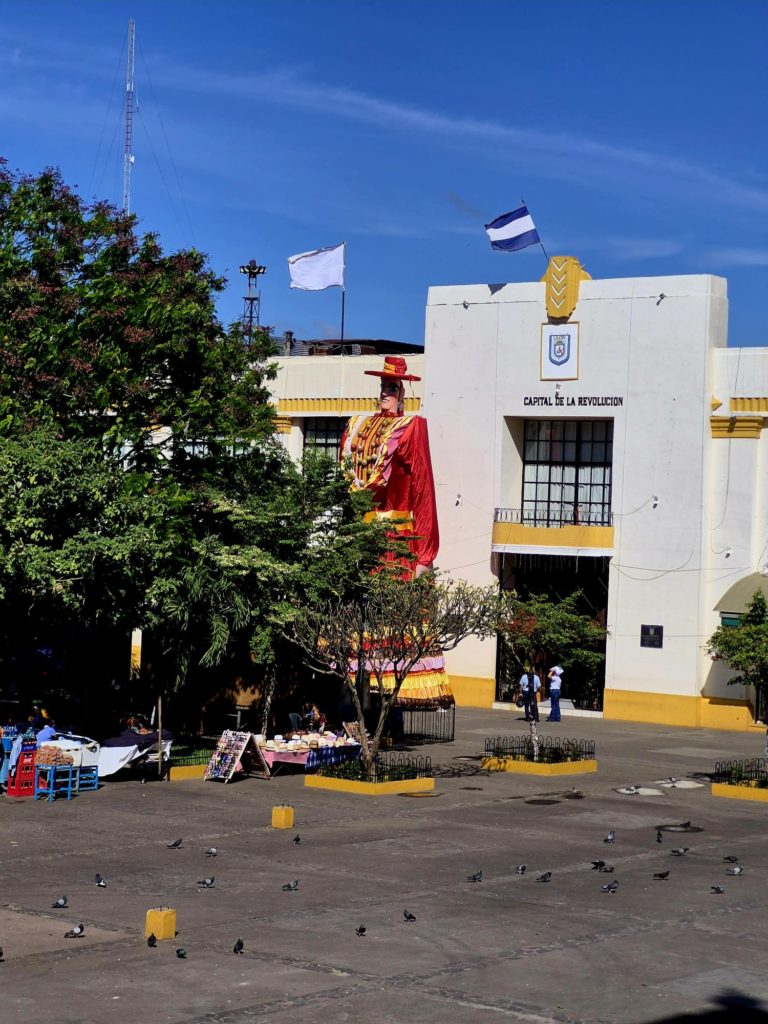
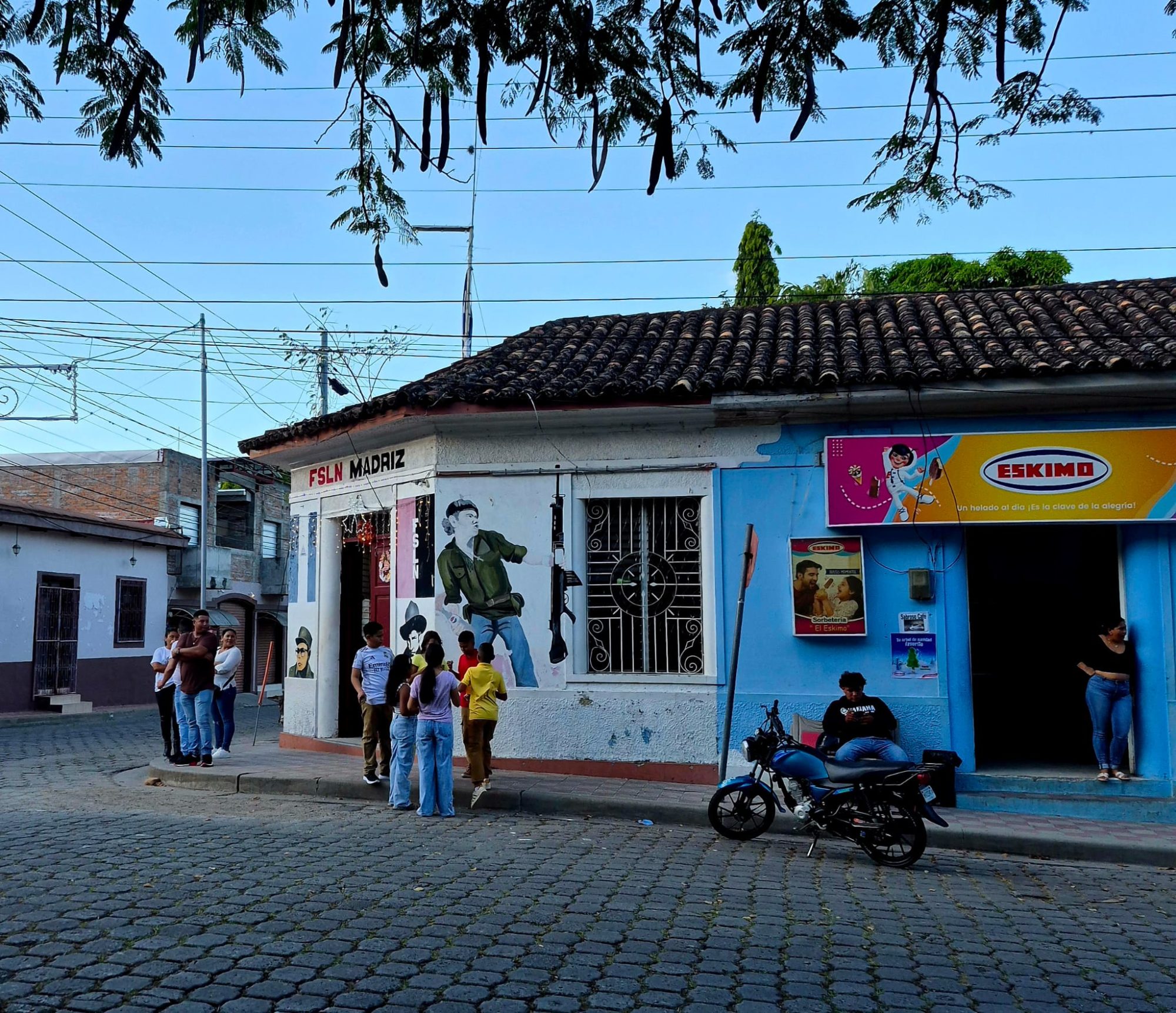
The constant presence of power is particularly oppressive. Foreigners with permanent residence in the country tell us about regular visits from the police or military. It’s not always about money, but often just about reminding people who can be their ‘friend’.
We experienced this ourselves on a coffee farm when a pick-up truck with seven heavily armed military personnel suddenly appeared in the car park. While one of them chatted with Michael, the others paid a visit to the farm owner – an unmistakable greeting shortly before the start of the annual harvest. As foreigners, they also have to disclose their complete finances; not a single penny can go to opponents of the regime, which means no NGOs either, as most of them were banned in the country in 2024. Even the Red Cross is now the White Cross with a blue background.
Similar to Venezuela, where we witnessed corruption first-hand, the population is deeply intimidated. People don’t talk about politics with just anyone, and when they do, they close the kitchen window first and whisper. You never know who might be listening in the backyard, even within your own family.
Despite these disturbing stories, we liked Nicaragua very much. We had no problems anywhere in the country, not even when entering or leaving. The people were friendly, open and curious. The country appears well maintained, even though you know that the money is urgently needed elsewhere.
It is definitely an exciting country to visit for a few weeks, but to live there permanently? The constant checks and uncertainty – what will happen next, what new law comes up, who wants money next… – mean that for me, it is not a place where I would want to settle.
Pingback:Where bibles are hidden and trees are made of metal – Travel & Wildlife