


The newly retired man with two cars
An old man was sleeping in the red, two-seater Corvette. We had already suspected as much, but it wasn’t until our new neighbour arrived that we could confirm it.
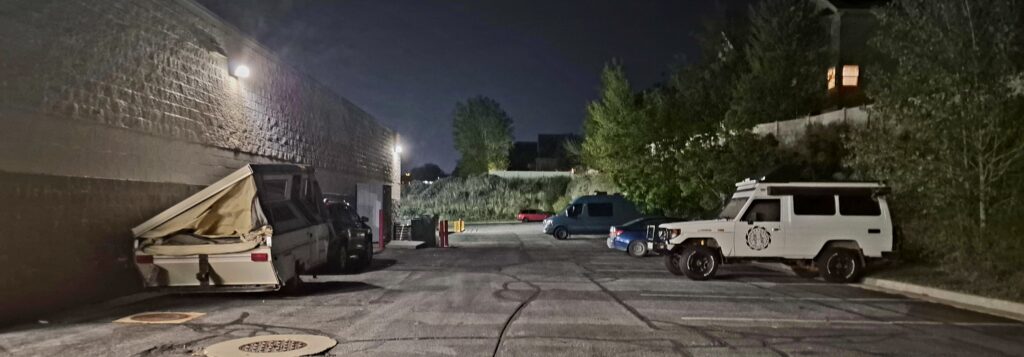
This new 66-year-old neighbour – let’s call him Dave – is privileged compared to the man in the Corvette. You see, Dave is parked here with two cars, effectively just waiting for his house to sell. To tie him over, he bought a white van two months ago for 5 000 US dollars. The black Kia saloon parked next to it is what he uses to get around town.
Dave spends his first night in the parking space next to us, and introduces himself the following evening: “I’ve been on my own for six years, let me buy you a beer.” He worked in construction his whole life. With his earnings, he bought a house built in the 1970s, and now he’s selling it to move to a cheaper state. While he waits for a buyer, he lives out of his car, showering at the gym thanks to a 10-dollar monthly membership, and hoping a buyer comes along soon. Once the house sells, he says he might give his new-old white van to a homeless person. Why he can’t just keep living in the house in the meantime is something he can’t quite explain to us.
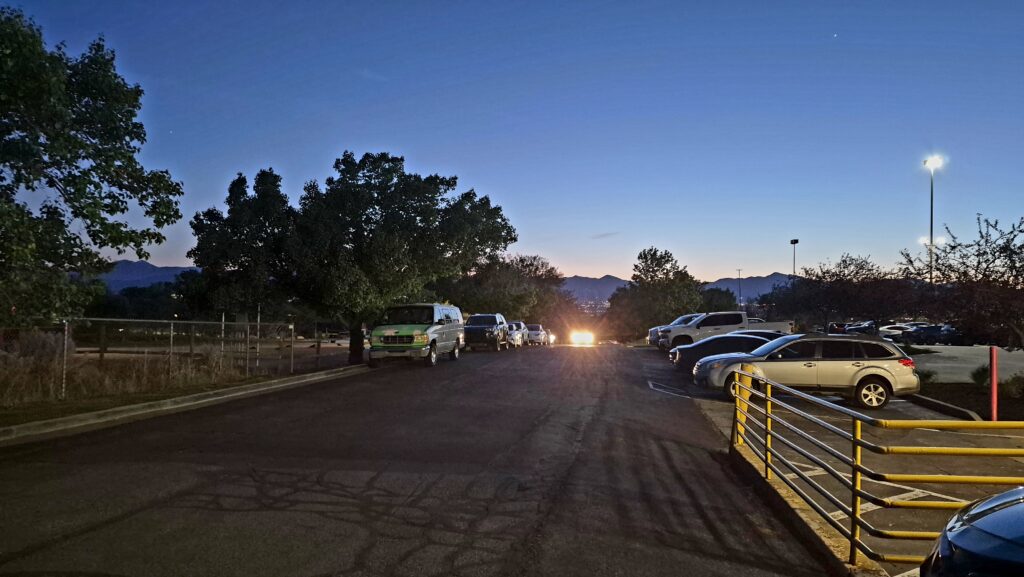
The beer is finished. By now, more vehicles have gathered in the gym’s large car park.
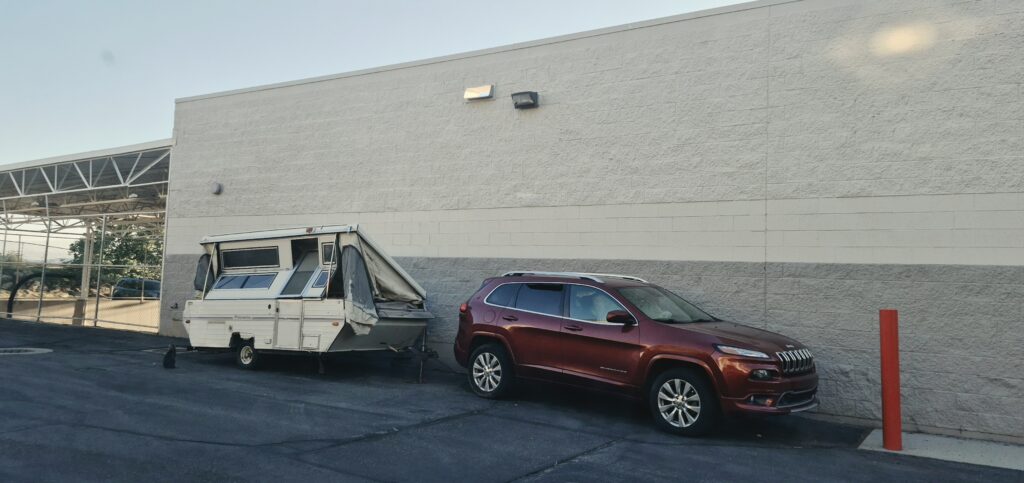
A green bus painted with yellow sunflowers is parked more crookedly than straight on the level tarmac. A cat stares out at us from a crammed white delivery van. A modern Sprinter parks around the corner, and a woman gets out of the vehicle with a cat in her rucksack. An old caravan, which looks completely abandoned and unroadworthy, is gone by the next morning.
Several SUVs and saloons are parked in front of the gym. People come and go all night long. Some drive home, but many simply climb into the back seat. Sunblinds hold makeshift curtains made of scrap fabric in place to cover the windows. What keeps the sun and the heat out during the day hides the dimmed light inside the vehicles at night.
Between the library and fast food: our own daily routine
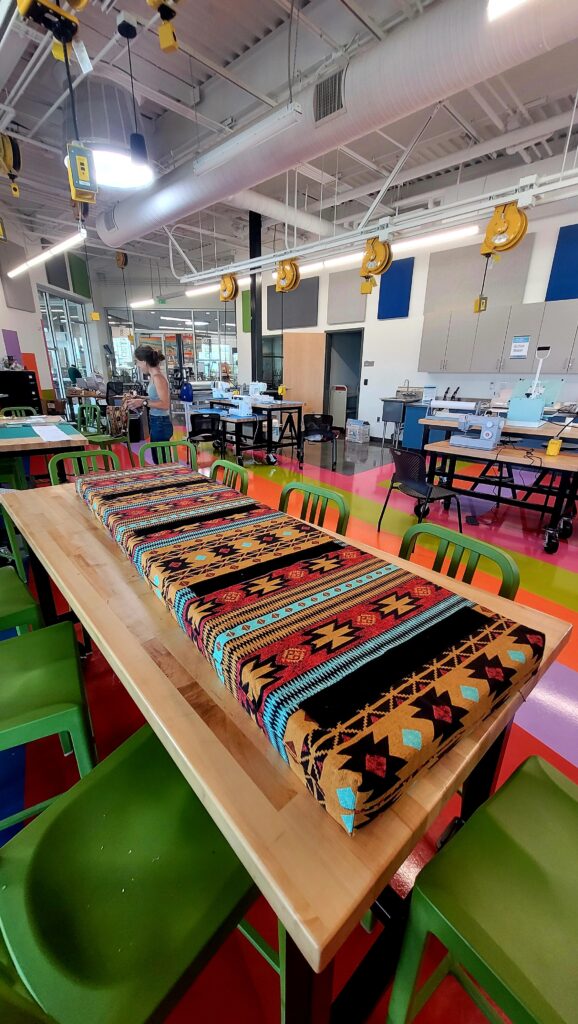
We spend two weeks in Salt Lake City. Because the campsites are extortionately expensive, we join the car park residents. During the day, we use the free sewing machines and facilities in the public libraries. For food, we hit the taco stand, grab six-dollar supermarket sushi, or opt for the five-dollar McDonald’s meal – healthy it is not. In the evenings, we sign up for a trial gym membership, do a workout, and have a hot shower. Then it’s straight back to the car: with the pop-top roof firmly closed, we sleep in the tight lower bed.
We feel uncomfortable opening the roof tent in the middle of the city; besides, everyone here is trying to fly under the radar. An open roof tent would be far too obvious – and there are fewer and fewer places where people are allowed to park overnight. So, it’s better to remain inconspicuous.
The circumstances aren’t exactly cosy, but we learn a lot: about our car park neighbours, about Salt Lake City, about the gym bros, and where to get cheap food. Over time, you also learn how to spot the cars people are living in.
Isaac and a van full of cats
The delivery van with the cat belongs to Isaac. One evening, as Michael returns from the gym, Isaac asks him if he wants to pop his head in for a moment. He has newborn kittens. Intrigued, Michael dares to take a look inside.
It’s true: the tiny cats are playing in the back, while Isaac sits on a rolling office chair.
He tells us that after his time in the army, he went back to live with his mother and was prescribed psychiatric meds. When his mother passed away two years ago, all he had left were the cats, his van, and his belongings tucked away in a self-storage unit.
He drives around every day doing what needs to be done, and in the afternoon, he and a mate hop onto electric skateboards to do laps around the gym.
Many people in the US live full-time in their vehicles
There are no exact figures for the number of people actually living in their cars. It is incredibly difficult to quantify. Some have genuinely become homeless and can no longer afford rent, but at least still have a roof over their heads thanks to their vehicle. Many others choose this lifestyle entirely by choice.
Do overlanders in their state-of-the-art Mercedes Sprinters fall into this category? Not really – there is a vast difference between still having a shower and a kitchen waiting for you at home, even if it is a car, and having to retreat to the cheapest gym every evening for running water while living off supermarket takeaways.
The scale of “vehicular homelessness” – as the phenomenon is known in the US – varies between 400 000 and over a million people, depending on the source. It largely comes down to the definition. Some include voluntary life in a car, while others only count the homeless who, despite losing their flat, can still afford a vehicle and its insurance.
According to the Department of Housing and Urban Development (HUD) , 771 000 people were homeless in the US in 2024. Of those, roughly half are said to live in their vehicles. A car is essential in a country where everything is built around driving. As a result, there are many who have jobs but simply cannot afford the price of housing, and so choose to sacrifice a home rather than their vehicle.
The abrupt end of the red Corvette
When you live in these car parks, it suddenly becomes entirely obvious which cars are inhabited. Some examples stand out straight away, like those barely roadworthy bangers that belong in a scrapyard. But then there is the blue saloon, the brand-new red Jeep Cherokee, or the beautifully converted old Ford truck. Or indeed, the red Corvette that parked by the kerb under the tree every single night.
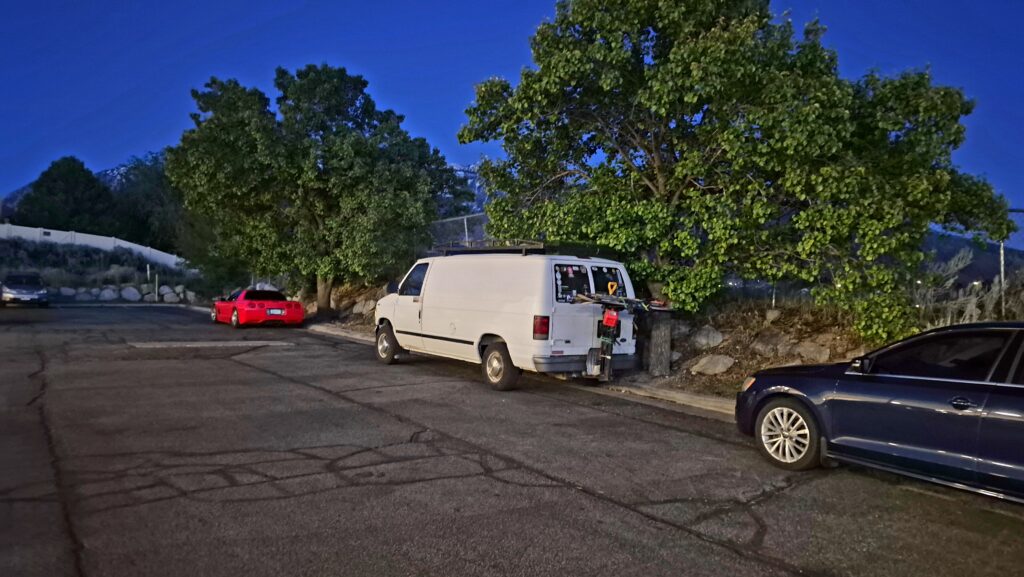
The sports car’s tinted windows only let you guess who is sitting inside. No one is ever seen getting in or out. In the morning, the two-seater is gone. The car seems far too cramped to live in. But when you have no other choice, you find enough space even in there. But what do you do when, one morning, a lorry rams your car and the police have it towed away? Where will the old man sleep tonight? We never found out. Dave could only confirm that our suspicion was correct: someone was sleeping in the Corvette too.
We mention this to some local acquaintances. The librarian in Salt Lake says she had heard of it but had never actually noticed it. It’s hard to believe when you think about just how many there are. Sadly, even people with good jobs are affected by homelessness.
The young firefighter
In another car park outside a Walmart, we cross paths with Matthew. He tells us he is a firefighter and that he lives in his car too. Matthew is young, and because he deals with wildfires, he gets stationed in a new area every summer. On top of that, they are on a 14-day standby rotation. When he isn’t out in the forest tackling blazes, he sometimes sleeps at the station, or just somewhere in the city in his car. For him, renting a flat isn’t worth it; after all, he’d only be home for one week out of the month anyway.
On this particular evening, he is on call. He spent the day at a shopping centre, worked out, and showered there. Now he’s looking for a dark parking spot to set up his small camp bed in the back of his truck. He has eaten fast food; though he owns a small camping stove, he says it isn’t really worth cooking for one.
In this Walmart car park, just before midnight, we count at least five cars with people sleeping inside. There are probably more, as plenty of other vehicles are parked up, but with many of them, you wouldn’t notice a thing.
The stranger in the red Jeep
It’s the same story with the red Jeep Cherokee. If it didn’t park in the exact same spot every evening, right next to us, we probably wouldn’t have noticed either. The car looks new, well-maintained, and clean. Who lives inside? We aren’t entirely sure. It’s a woman – Black or Latina.
Before reversing into her spot, she always pulls a curtain across, so she actually parks blindly. During those two weeks, she never once stepped out of the vehicle on site. Sometimes in the evening, the glow of a mobile phone flickers through the gaps in the curtain. We only saw her once, driving past.
Forty per cent of the homeless population in 2024 were women. Many of them live in vehicles because they feel safer there. And yet, seemingly never safe enough. Our neighbour clearly doesn’t want anyone to realise that she is a woman sleeping alone in a car.
We ask the others we’ve met in the car park, but they don’t know her either. Nobody knows her name or even what she looks like. Only the immaculate red Jeep and her regular absences suggest that she has a job to go to.
Fewer, and yet somehow more
While official national statistics pointed to falling numbers years ago, the reality is that since the pandemic and the subsequent inflation, the number of homeless people has skyrocketed once again – and the dark figure hidden away in cars is vast.
Life in a vehicle is not comfortable. Most lack basic amenities like a toilet or a kitchen. They are ordinary cars, the kind you see on the streets every day. Except that at night, the back seat becomes a bed at best.
Just sorting out the daily logistics is complicated: food, toilets, showers. On top of that comes the bureaucracy, because they don’t have a fixed address.
We have a genuine luxury setup by comparison, and we chose this lifestyle. Being forced to spend every evening alone, never knowing if the police will knock on the window or if the car park will be closed off, wondering where and what you can eat, is definitely nothing to aspire to.
The problem is far bigger than many people think. It’s barely noticeable at first, until you train your eyes to see it.
Then, suddenly, you see inhabited cars everywhere.