


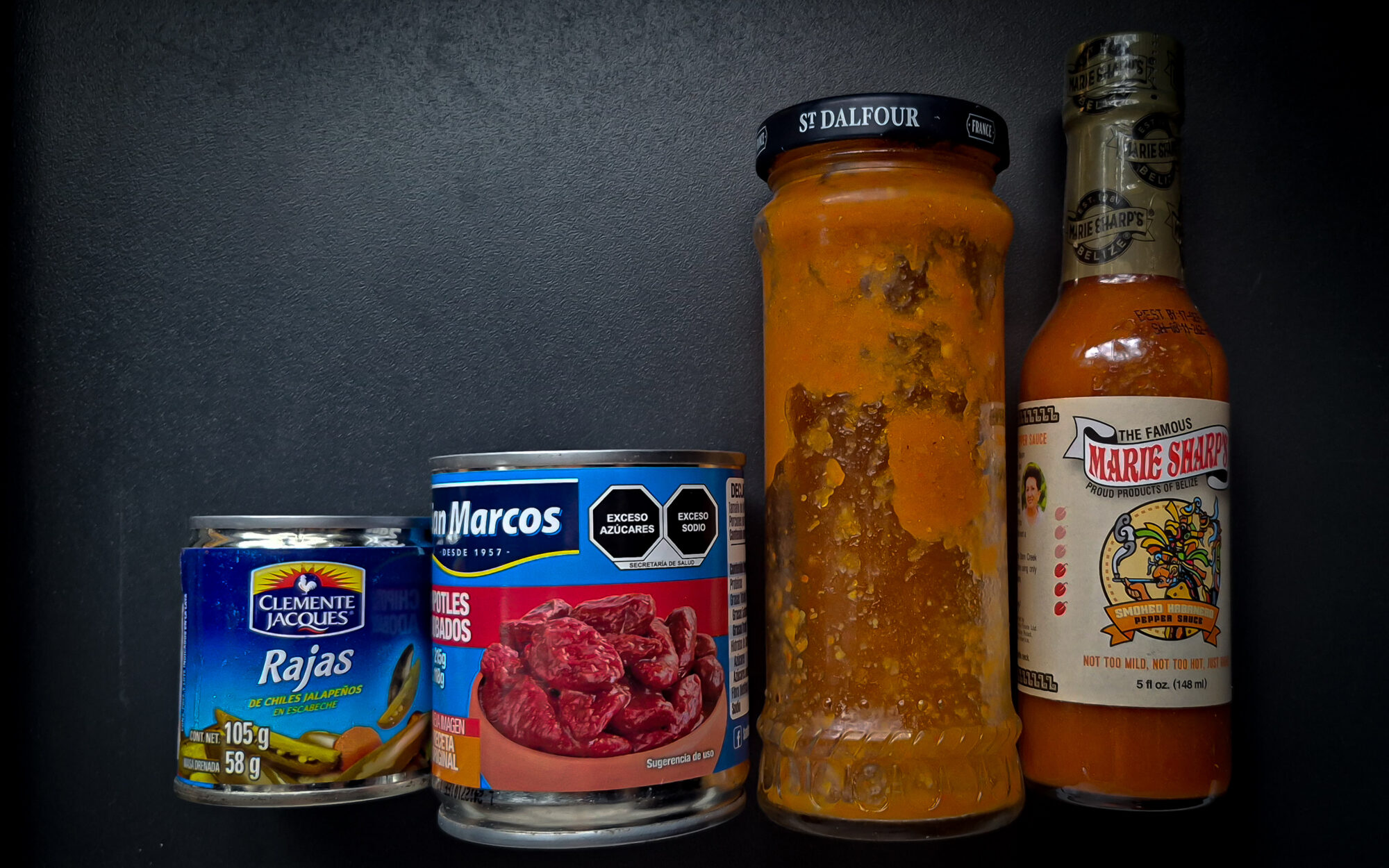
You can’t find any Tabasco sauce in Tabasco, Mexico. Did you know that? In fact, tabasco sauce does not come from the Mexican state of Tabasco. It’s an US product made using Tabasco chillies – that’s where the name comes from. We learnt this when driving through the real Tabasco.
As it’s not our preferred chilli sauce, we weren’t too disappointed. It’s nowhere near any of our favourites, although it is the best known worldwide. We don’t keep Tabasco sauce in our fridge, but we definitely always have chilli sauce on stock.
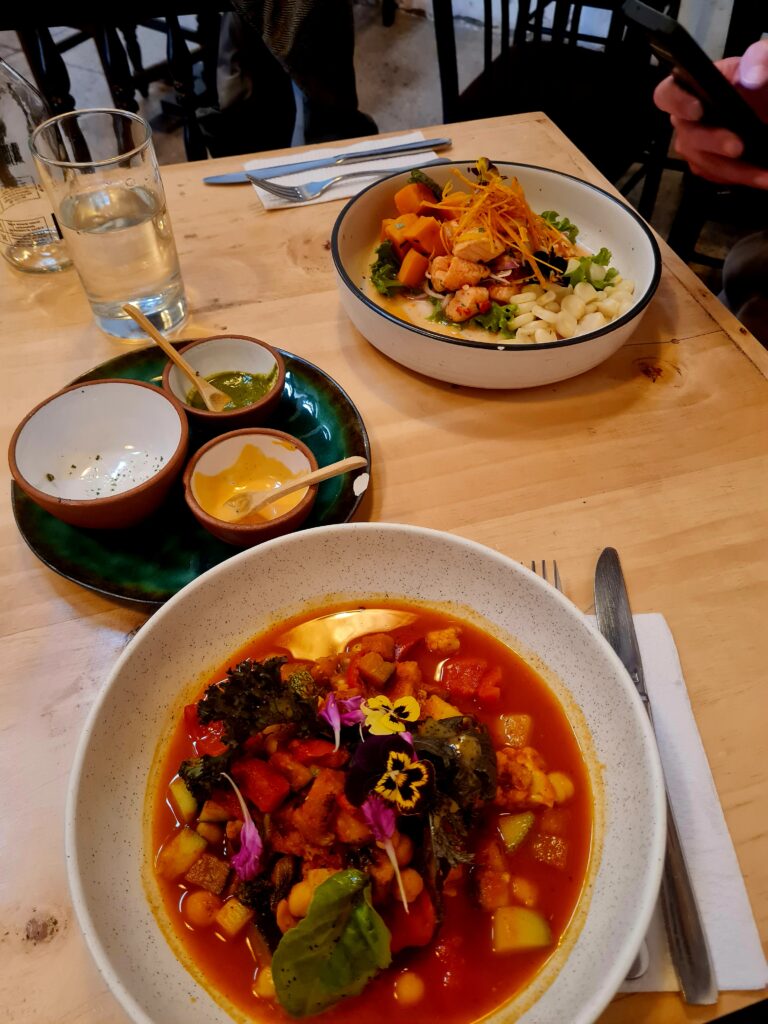
The best ones we have tried are still homemade. You can usually find them in any restaurant across Latin America – just ask for salsa picante, chile or ají, depending on where you are. You won’t find the same flavour twice, even if it’s called the same, but at least it’s always spicy. Sometimes, when we really like it, we ask the restaurants if we can buy some of their sauce to take away. And they are usually so proud that tourists were buying their hot sauce that they gave it to us as a gift. Our favourite so far? Miss Liz’s habanero sauce from Belize.
A tour that wasn’t one
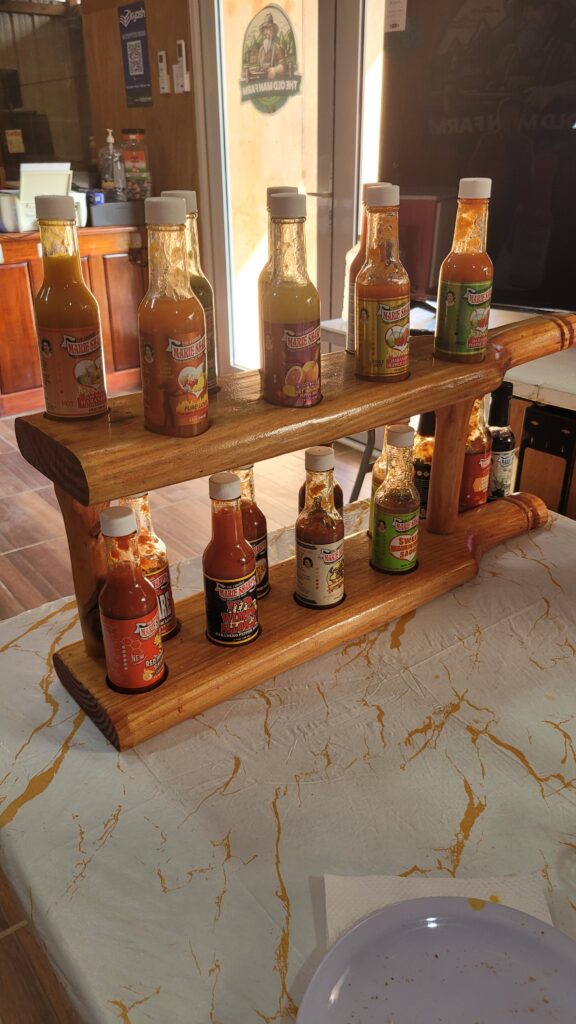
We saw so many chillies on our journey through the Americas that we had to visit a factory. In Belize, we passed Marie Sharp’s. It’s another well-known brand, so we took it as a hint and stopped.
The ‘tour’ itself isn’t a proper tour of the factory; it’s more of a video. This was a bit disappointing, though the second part was well worth it: tasting 32 spicy products! Some were spicier than others, and by the end our mouths were numb.
We drank plenty of orange juice and ate lots of crackers with each spicy product during the tasting – and yes, you really need to love spicy food! In the end, the smoked hot sauce came out on top.
Chillis are Americans
The chilli plant originally came from the Americas. Scientists think that it spread from what is now Peru and Bolivia, but was first cultivated in Mexico. Experts estimate that there are between 3 000 and 4 000 varieties of chilli pepper in the world.
It is believed that the Aztecs used and cultivated chilli as far back as 7000 BC. The importance of the Aztecs for the chillies is even reflected in their name: ‘chilli’ is of Nahuatl origin, the language spoken by the Aztecs. However, chilli did not conquer the rest of the world until Columbus discovered it on his first journeys and brought it to Europe. This explains the second part of the name: ‘pepper’. Columbus was looking for pepper, which he didn’t find. However, he thought chilli was similar enough.
He had big plans to convert it into the newest gourmet spice. However, it wasn’t very popular in Spain as it was too spicy for people who preferred the milder varieties, such as bell peppers which became very popular across most European cuisines and was a bit spicier in the east.
It’s interesting to think that very spicy cuisines such as Thai and Indian didn’t use chillies before, yet they’re now an essential part of them. They had other spicy spices, such as pepper, but nothing quite like it – well, maybe Japanese wasabi.
Thousand names for one thing: cayenne sauce, chile, ají, chipotle…
One of the first commercially produced hot sauces appeared in the US around 1807 in the form of a bottled cayenne sauce. Since then, it has grown in popularity all over the world.
Hot sauces as we know them today are therefore a relatively new product, although the tradition goes way back. It’s amazing to think that the rest of the world didn’t know about this type of spiciness until the Spaniards arrived in America.
Hot sauce emerged as a means of preserving and enhancing flavour. The Aztecs and Mayans also used it as a remedy or to punish people by burning chillies to produce a burning smoke.
Our tasting session at the production site in Belize was definitely not a punishment! It was amazing to experience all the different flavours, and there are many, many more to discover. At Marie Sharp’s they mainly work with habanero chillies.
In South America, aji sauce is more common. ‘Aji’ is another name for chilli, and as a sauce it is usually mixed with onions and some tomato; further south, it also contains a lot of coriander. But not necessarily. They use other types of chilli, such as rocoto or aji.
In Costa Rica, if you want hot sauce, you have to ask for chimichurri, which is similar to ají sauce in the south, but has nothing to do with Argentinian chimichurri. In Central America, you can basically ask for chilli, or more specifically, ‘salsa picante’. Then you’re sure to get homemade sauce.
In Mexico, most things with chipotle are spicy. They have so many spicy sauces that they’re rather specific at naming them. However, there’s always a spicy and a non-spicy option, so just ask. Don’t assume that if the salsa verde is not spicy in one place, it will be the same at the next.
We’re still working our way through the large jar of habanero chilli sauce that Ms Liz gave us in Belize. Over a month later, we still have some left. Although it’s very good, you can’t put too much of it on your food — it’s really spicy!
Next on the chilli list? Well, we’ll see what’s new to try in the next region.