


183 days in figures – a review of the geographical central part on our journey
By the time we leave Central America, we have been on the road for 868 days. From Colombia, the car was transported by container ship to the Caribbean end of the Panama Canal, to the port of Colón. We were able to collect the Land Cruiser there on 8th August 2025. And on 3rd February 2026, we crossed the border from Belize into Mexico, thereby leaving Central America.
So it’s time for another look back.
We’ve driven a lot again, but as the region is quite small, it’s nowhere near as many kilometres as in South America. Just 7608 kilometres criss-crossing Central America.
How far?
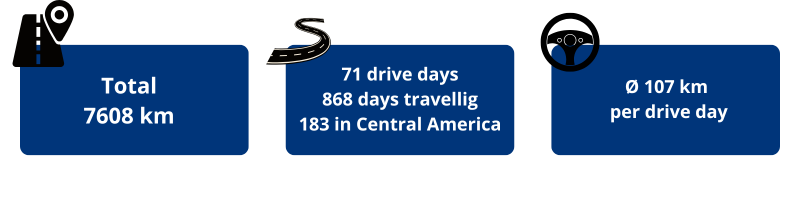
In total, we covered 7608 kilometres in 183 days. From Colón in Panama to Orange Walk in Belize. That works out at an average of 107 kilometres per day on the road. Our longest single-day journey, covering 306 kilometres, was in Costa Rica from Cóbano to Liberia, where we went to meet Michael’s niece.
In Central America, too, fewer kilometres still mean many hours on the road, yet the roads are generally in better condition than in South America.
We spent the longest time in Costa Rica – mainly because we were visiting family. We covered a total of 2856 kilometres in Costa Rica alone, and as the country is rather small, we’ve now got to know many parts of it. In second place is Panama with 1218 kilometres, followed by Guatemala with 925 km. We also spent some time there at the mechanic’s, as the car had reached 200 000 kilometres and was due for a full service. During this time, we drove around Lake Atitlán in a rental car with Michael’s brother and his girlfriend.
We actually covered a few more kilometres in Guatemala, but as we always count the day we cross the border towards the destination country in our statistics, many kilometres are added to the total for Belize.
How many litres?
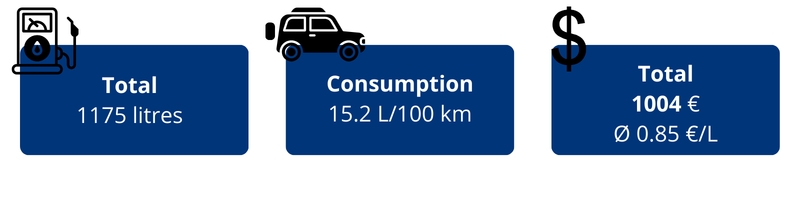
We used 1175 litres of diesel and refuelled 18 times during this period, averaging 65 litres per fill-up. Fuel consumption has settled at 15.2 litres per 100 kilometres, an increase of almost one litre compared to South America. This is probably due to the shorter distances, as the Land Cruiser uses even more fuel over shorter journeys. Or perhaps because we used the engine more often as a generator, as we had a lot of rain and needed to charge our batteries. The solar panels weren’t powerful enough for that with all the rain.
In total, refuelling cost 1004 €, which works out at an average of 85 cents per litre – exactly the same as in South America. Here in North America, it’s unfortunately quite a bit more expensive, but more on that when we’re back in Europe. The cheapest place to fill up was Panama, at just under 75 cents per litre. The most expensive was Nicaragua, at 1.07 euros per litre. In Belize, we knew the price per litre would be very high, which is why we topped up in Guatemala and didn’t need to refuel in the country itself. [Based on exchange rate francs to euro on 19.03.2026].
Unlike in South America, we never had any trouble finding diesel. There are petrol stations even in remote areas. That’s why we hardly used the auxiliary tank.
And what else?
We collected data throughout the entire trip. Every time we filled up with petrol, we had to convert the price into Swiss francs (and into euros for this post) and often from gallons to litres as well. Every evening, we reset the odometer to zero and noted down the starting point, destination and distance. The result is the data we present here.
The summary shows once again everything we experienced over the 183 days. We set off from the Waldorf Astoria in Panama (thanks to our shipping partner) and stayed in Belize a week longer than planned, as we were invited by locals to eat, drink and go boating.
In Belize, we trusted the locals so much that we got stuck in the mud and couldn’t get out on our own. Someone had to pull us out for the first time. In the process, they nearly ripped off our rear bumper. In Costa Rica, we were able to help another local out of a tight spot in return. Michael also caught a calf that had escaped from a trailer involved in an accident. Otherwise, not much happened.
There were hardly any checks and our border crossings always went smoothly. We were even allowed to take our food and alcohol (at the Guatemala–Belize border) into the new countries.
In Central America, it was the first time we had to pay a fee for every border crossing: usually it was less than 10 dollars. We also had to pay for the car’s import permit suddenly, on top of the third-party insurance. We hadn’t come across that before on our travels, the south all paperwork was free.
Of course, the Land Cruiser was also looked after and maintained: In Panama, the roof was resealed; in Costa Rica, an extra leaf spring was fitted; in Nicaragua, the exhaust pipe had to be resealed; and in Guatemala, a full service was due. Just before crossing the border from El Salvador into Guatemala, we had 200 000 kilometres on the clock.
There were hospital visits again too. In Nicaragua, we ended up in A&E; it took less than 10 minutes. Diagnosis? Too much gas in the gut. Treatment? Medication for a week. As things didn’t improve, Cora went to a clinic in Antigua, Guatemala, again to get checked out thouroughly. Conclusion: it’s nothing serious, the cause remains unknown.
Michael also had to go to A&E once. Due to a severe flu and low oxygen saturation, Cora insisted he see a doctor. We also had some routine dental appointments, one of those things that are just part of life.
People often ask about police checks and corruption. So far, we’ve got off lightly. In Central America, we didn’t have a single police check, except at the borders. That was quite unusual for us as in the South we had many.
We’ve visited all seven countries in Central America – at least the mainland part, for the Carribbean we’d need a boat. There are still more places to discover in every country. But we simply can’t do everything.
Now it’s time to discover North America. Endlessly long, straight roads await us there, and once again we’ll have to make lots of decisions about exactly what we want to see and what we can manage..